
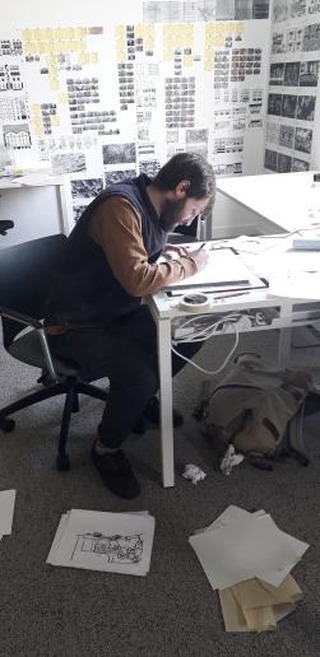
Jordan Antonowicz-Behnan is a filmmaker, animator and visual artist based in Hastings. Behnan’s practice borrows largely from Assemblage; any item can be utilised in his work, and his animation style is unpolished, complementing his hands-on approach to filmmaking. His animated documentary A Taste for Music (2022) was his graduation film from the Royal College of Art’s Animation MA, and has shown widely, including at Animafest Zagreb, Edinburgh International Film Festival, and New Chitose Airport International Festival. We asked Jordan some questions about the development and production of the film.
Did you study animation prior to coming to the RCA?
Yeah, I studied at Middlesex University with Jonathan Hodgson, Osbert Parker and Robert Bradbrook.
And had you done any documentary work?
I did an apprenticeship for about nine months in Barcelona, learning how to make documentaries. That was with a company called Otoxo. That was mostly handheld, live-action. But I felt I was more of an animator, really. At RCA I did an animated documentary elective with Bunny Schendler.
When did you begin to develop the idea for A Taste for Music?
I think it existed in some way a couple of years after my dad died. I’d been to India and Spain, and when I came back, I was living in my dad’s house during lockdown. Being surrounded by his things was a big part of why I made the film. I submitted it as an idea to Screen South, but it never got taken. At that time, I was trying to do it more about the music side of things. My dad used to run a record label. In the second year at RCA we had to come to a tutorial with two film ideas, and most people persuaded me to do the one about my dad. Even then, it started out more on the music side, and then developed into something more about grief and loss and that kind of thing.
Can you describe your development process?
The writing began with me just sort of writing different sort of poems, or different pieces, then reassembling them. From there, it moved into an animatic and then constant changes. The writing stayed pretty much the same across nine months at RCA, but the visuals kept changing — probably every two weeks. Deciding what to include and what not to. Originally, I was going to include my brother and sister, but with animation it was easier to have two characters rather than four. So, working with time and restrictions and the medium was also a reason why the visuals changed and changed. The idea of drawing on record sleeves, too, didn’t come straight away. That came from trying out animation tests, then I was like “I could try that”. There’s a lot of dirty old record sleeves knocking about in the world. I’d say the film is about 40% animated on record sleeves.


How did you integrate all the different visual elements?
I’d do the animation first, then I’d sort of go over it on record sleeves. And it’s just like traditional hand-drawn on paper. But I’d gather material between it and sort of improvise into it, in and out. That was quite a joy to do, actually. I used these old magazines that he’d collected and, you know, overlay them. Most of it was done physically, not in After Effects. And that made it easier, to make this film. Having an element of planning, but also… it’s character animation and you’d have the character move from A to B, but with these record sleeves, you’ll have holes in the composition, like a removed area of the composition. So, you could kind of play with that and overlay it. It just made it a bit more fun, and easier to make. You could kind of improvise a bit, get a few magazines or whatever, a few record sleeves, and maybe a poster, a music poster or something, and kind of just play with it, together. It had a somewhat experimental approach, in a way.
Were there techniques you tried and liked but that didn’t make the final cut?
I did do this kind of abstract triangle-and-circle sort of thing. Visually I liked it, but it didn’t make much sense as a form. Early experiments were a sort of exercise of warming up.

The film has screened widely. Did you travel with it?
I went to Zagreb and Stuttgart for international screenings, and I did London International Animation Festival and Edinburgh too. I also went back to Hastings, where I’m from, and had a screening there. A lot of family and friends came. That was a completely different experience — showing it on home territory where people knew the background. That Q&A was the most standout. A friend who was living with me, who knew my dad quite well called me out on part of the scene, saying “wasn’t your dad’s last gig at the Jazz Cafe seeing Ned Doheny play?” He was correct, and in that scene of the film it’s not Ned Doheny it’s La Perfecta. I changed it because I wanted use some of the music featured on my dad’s compilations and the music from his record label, and changing the music helped me tell the story and convey the emotions that are in the film.
Did you feel torn between truth and story at any point?
I think it’s 90–95% correct. I still have that sleeve, that he wrote the track list on. Obviously I have a different version of the truth to my brother and sister. I went with what felt honest, or what helped the story to be told, so that I could say what I wanted to say as a filmmaker.
One striking thing is how the film balances light and dark, and doesn’t idealise your dad or your relationship with him. Was it difficult deciding what to include, and did you feel you had to self-censor at any point?
There’s a scene where I’m putting the middle finger up. But that was like, almost a bit of a joke. In these times it was just me and him for a lot of it. It gets heated – the sick person isn’t happy because he’s ill, and he’s about to die. And the alive, the son, is kind of annoyed that his dad is angry. And so you do have this conflict. It’s difficult to explain. But the main thing I wanted to censor was any photos when he was, like, skin and bones. One thing you learn in documentary filmmaking is you need to have respect for your subject. And I don’t think he’d be happy to have photos of him like that exhibited. And a lot of these moments aren’t documented. There are photos where he is skinny and bony but not a lot because, you know, people aren’t usually happy at this particular time, so we’re not taking a lot of photos. So, I was trying to show the positive and rewarding memories I had with my dad within the last year I spent with him. And amongst this, animation is a way of documenting the undocumented, and that was what I was doing with the film.
What was the biggest challenge in making the film?
I didn’t want to offend my relatives. I made it for them, over anybody else. That was my target audience.
The film’s online now. Who do you hope it reaches?
I’m happy with where it is now. It’s a Vimeo Staff Pick, which is great, and it seems like it’s getting viewed so that’s what I’m happy about. Hopefully people will watch it in ten, fifteen years.
And what are you working on next?
I’ve got some support to develop a new film. Themes are like repetition, street art, freedom, and anxiety. I can’t say too much yet, but I’m using a style similar to a previous experiment I did, which is a film called Staring at the Wall, Looking at the Floor — sticking hand-drawn animations physically onto walls and floors in urban environments.
___
Jordan Antonowicz-Behnan spends a lot of his time in charity shops and going for walks, and his work is influenced by the things he sees, hears and finds. You can find more of his work on Vimeo and follow him on Instagram.
Interview by Carla MacKinnon.
 ANIMATED DOCS