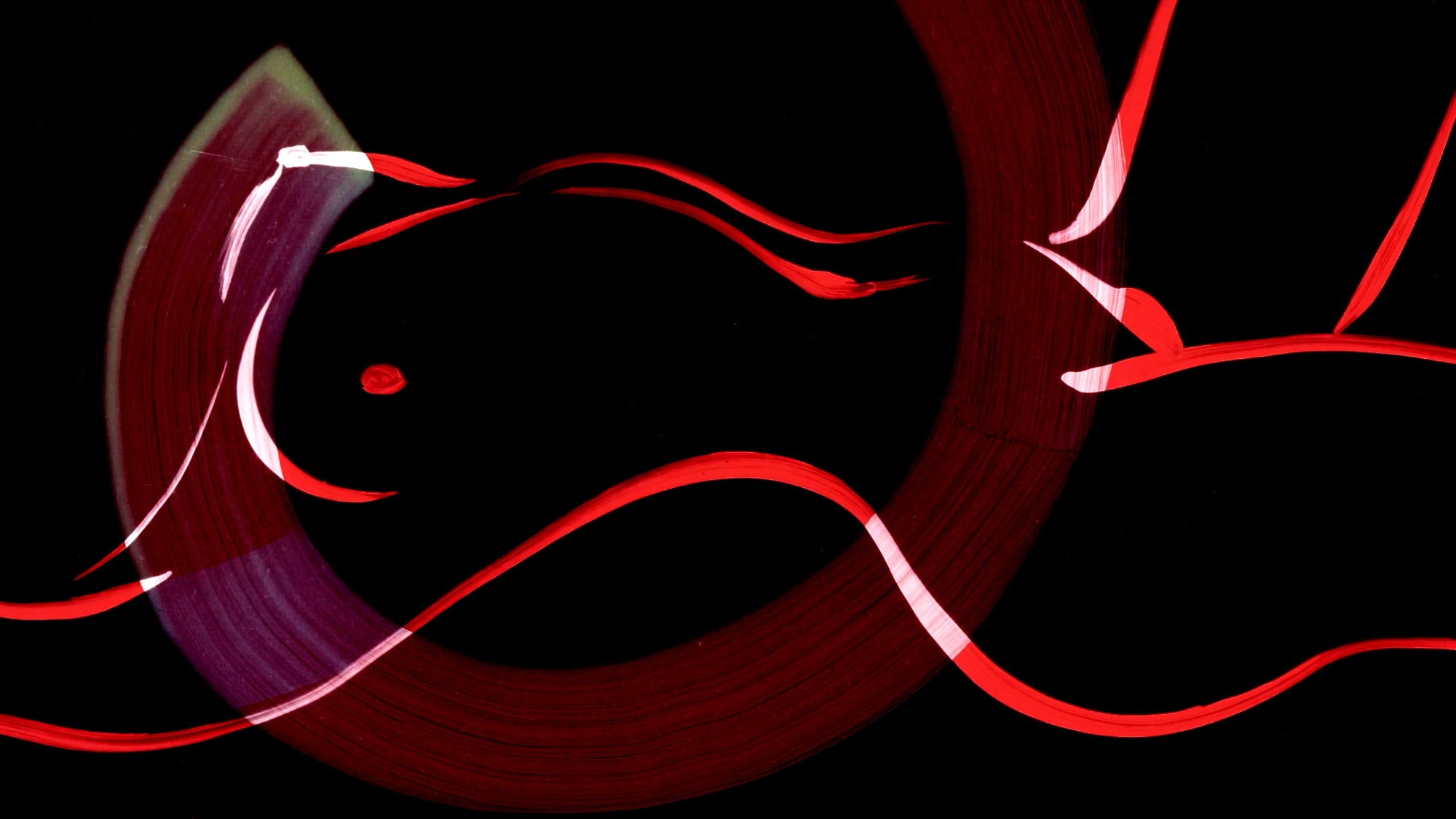
• Cecile Fountain-Jardim is an American animator based between London and New York. With a practice centered around storytelling through image, she uses tactile, mixed-media animations as the medium through which to create and tell intimate human-centered narratives. An RCA MA Animation graduate, Fountain-Jardim’s films have been screened at venues such as the British Film Institute and the BBC Television Centre in London.

    We interviewed Fountain-Jardim about her 2026 film Doug + Me, an autoethnographic animated documentary short centered around the story of her uncle Doug, a victim of the 1990s AIDS epidemic.

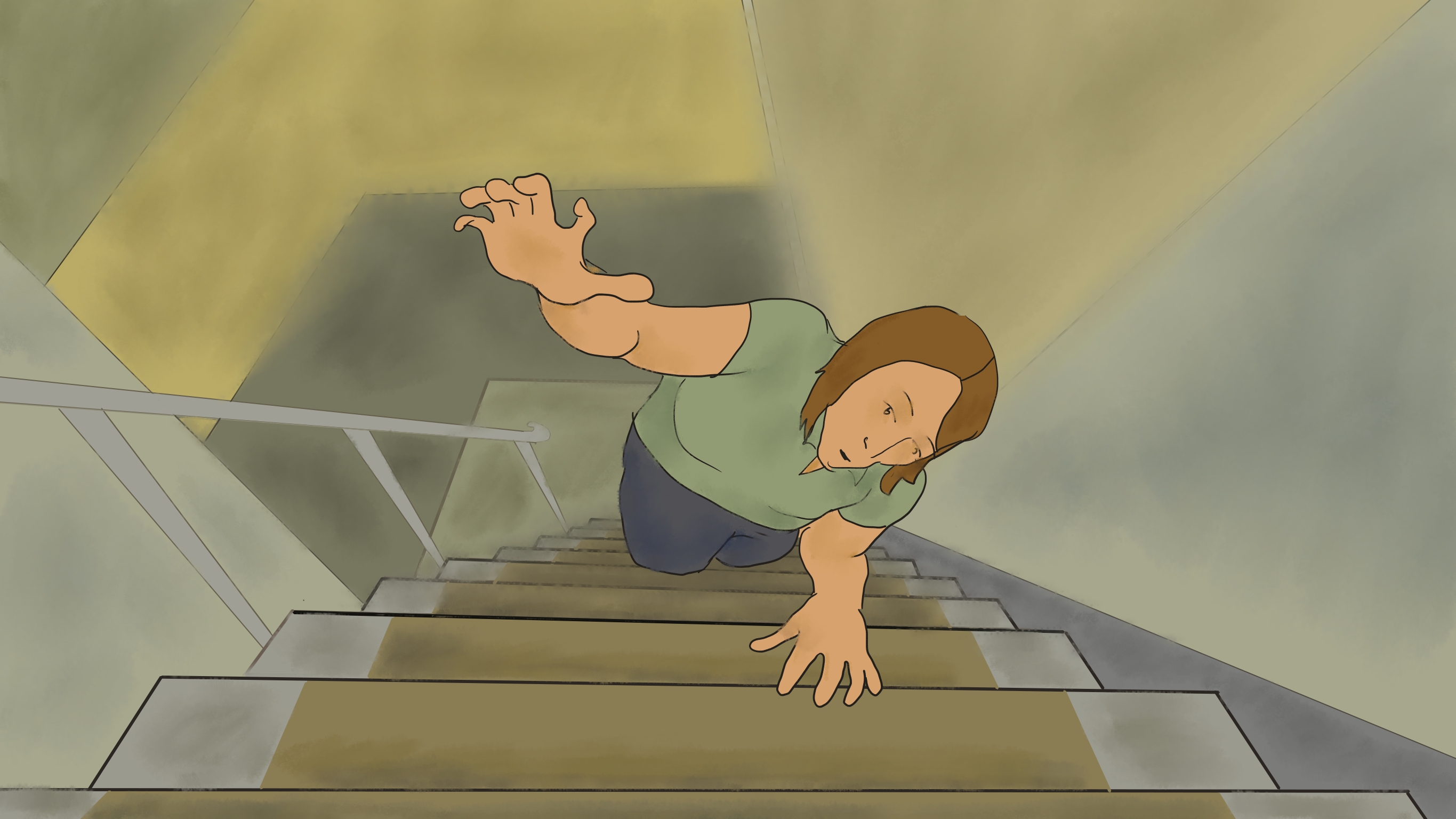
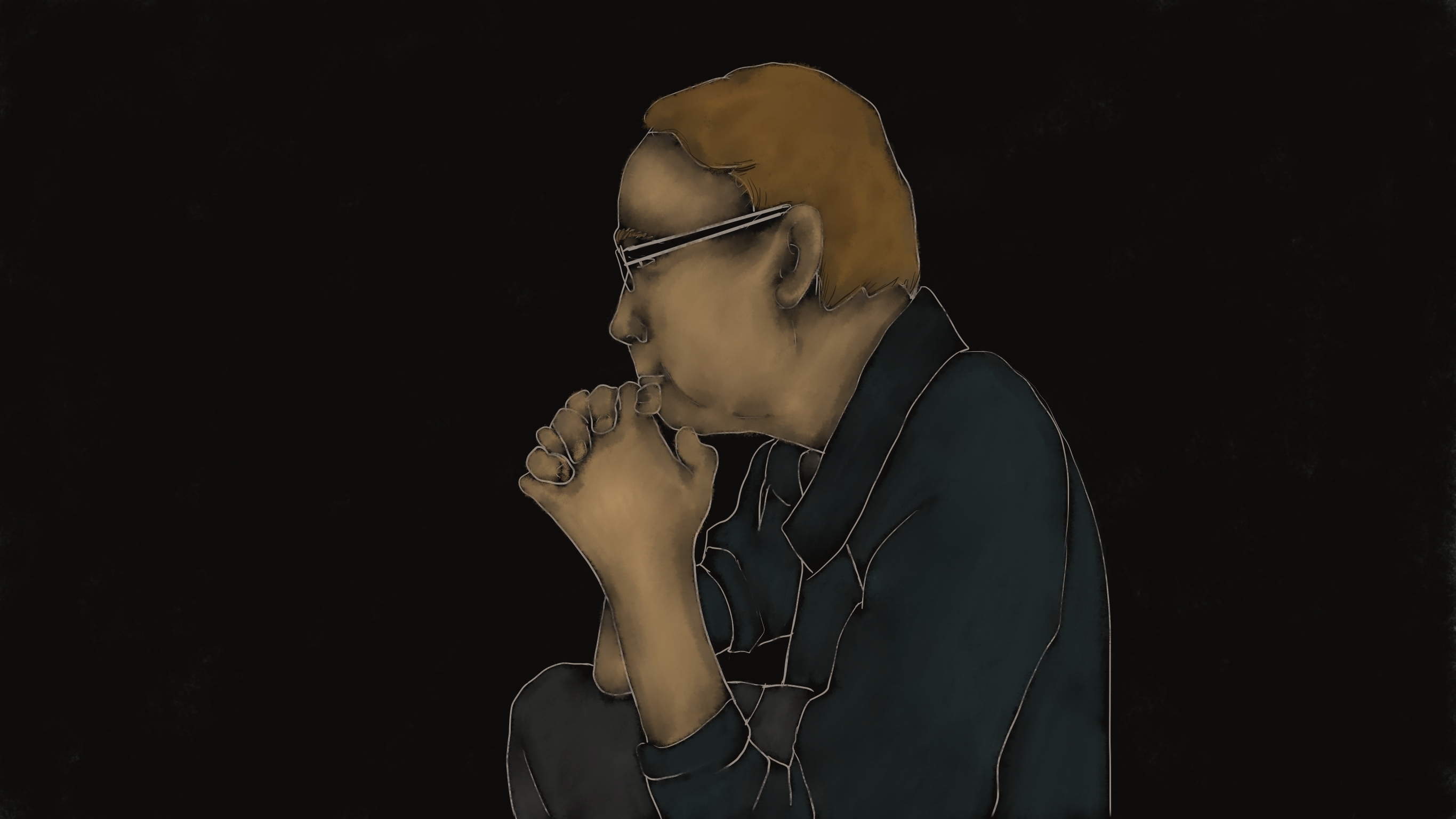
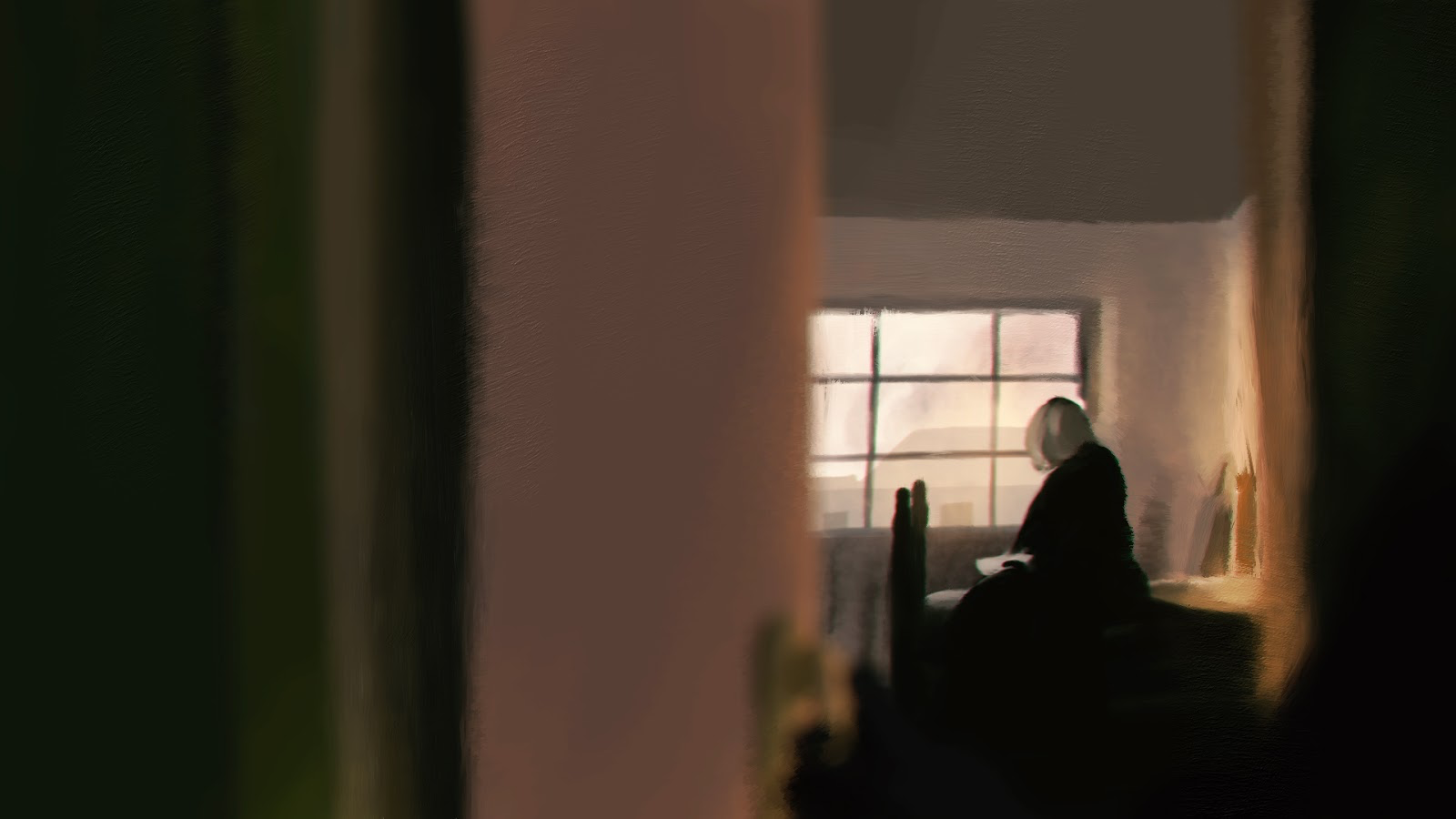
    Doug + Me, 2026


    Can you describe the initial development phase of this film? Why did it feel like the right time to tell the story?
    I had been thinking about making this film for quite a while, about a year or two before I started making it. I had gotten to the point in my practice where I had started thinking, “What can I make that feels like the most important thing I could possibly make right now?”, and this story was the answer to that. I’d had it in my mind for a few years that this was a story that I had to tell, and something in my life that I wanted to explore and come to understand through the making of a film. I want to tell stories that resonate deeply, to both myself and others, and this was such a resonant story to me that was begging to be told at some point. When I started my MA at the RCA, an entire year of dedicated time to focus solely on a single project, it felt like the right opportunity to give the space and profound focus to this story that I felt like it deserved.

    Were there any particular influences or inspirations in terms of other filmmakers or artists?
    From the start, story-wise, I focused a lot on films like Mommy by Maggie Lee, Love, Dad by Diana Cam Van Nguyen, and A Taste for Music by Jordan Antonowicz-Behnan. All of those films had done something that spoke so strongly to what I wanted to do with this film, both visually and in terms of tone and storytelling. I loved how they all told stories centered around an extremely personal history relating to a family member, at the core of which were the expression of deeply-felt human emotion. All of those films feel so authentic and full of heart, and work so well to make the viewer feel something. I saw those films and thought, I want to make a film that does the same thing. Visually, I was very strongly inspired by all of their collage-like styles, and the way they wove together archival elements like photos, footage, and documents with animation, in a way I found very personal and tactile and lent such emotional accessibility. I wanted to use a similar visual style for the film in a way that felt like flipping through an archive of someone’s life and memory splashed onto the screen.

    Beyond those films, I took a lot of inspiration from AIDS documentaries from the 80s and 90s such as Life and Death on the A List and Common Threads: Stories from the Quilt. I really studied the way that they approached telling the story of AIDS from such a deeply, emotionally, human perspective. They focused in on individual stories within this huge historical tragedy and really communicated the weight of those individual losses. There’s a quote from the documentary Paris is Burning in which a subject says, “You left a mark on the world if you just get through it and a few people remember your name, then you left a mark. You don’t have to bend the whole world”. That was hugely influential.

    Were there any complexities involved in telling such a personal story? How did you approach involving your family as interviewees?
    Yes, and this was definitely something that was very much on my mind from the start of making the film. I love making very personal films. I think many of the strongest films are deeply personal, because so much of the artist gets put into the film, and the resulting work reflects the maker so deeply, in a way that cannot be done by anyone else. I think there’s a lot of strength to the advice, “Tell the story only you can tell”. But telling such a personal story definitely makes the entire process feel quite fraught in a way, because it’s so wrapped up in so many emotions and ties you have to the subject material and the people in it. You’re so close to the material, and while that’s a strength in many ways, it can also blind you in others, and complicate decisions about what you ultimately decide to put into the film. When I was conducting the interviews with my family members, it was with people I know and love, and I was really comfortable with them off the bat, which is an amazing thing to have for an interview. But I was also very aware of the fact that it was a sensitive subject for them, something that has hurt them deeply and that they are still dealing with decades later. You of course never want to hurt the people that you love, whether that’s with the interviews or with the final cut of the film. So there’s a bit of a tension that exists between wanting to be sensitive to them but still making the film that wants to be made, without having what you think they want to see and hear affect that final outcome to an extent that makes the final film less good than it could be.

    But again, it was also such an asset, because I could also do so much with the interviews that I couldn’t have done with strangers or people less close to me. When I conducted the interview with my mom, she cried almost immediately, and I knew that that was okay because there was a trust and level of comfort there that wouldn’t be there with others. And in her interview, we conducted it as she was flipping through photo albums, rather than in a normal sit-down interview, and that ended up being the strongest interview I got because of the fact that I did it that way. I wouldn’t have conducted that interview in that way with anyone I was less comfortable with, and being so close to her lent such a strength to her interviews that really led to such an amazing result to come of it.

    Did you know you wanted to use a mixed-media technique from the beginning or did this evolve during the development processes?
    I did know from the start that I wanted to use a mixed-media technique to tell the film. I love using found footage in my films. I love pulling in found photos, and documents, and ephemera, and having it be tactile and cluttered and unrestrained. I love tactility. I love having the fingerprints of the maker all over the film, and leaving no question over whether it was made by a human being. I was so inspired by films such as Maggie Lee’s Mommy that use a collage of found and created elements in a way that just feels so bursting with creativity and heart. Watching that film, I felt so connected to her. That film feels so deeply human and so deeply emotional, and I think so much of that is because of the visual style, because she brought all of those collaged archival elements in. The mixed media nature of it makes it feel so unedited, so unpolished, so raw, and therefore so authentic. I came into this film knowing that I wanted to do the same thing. I wanted to use a visual style that made the viewer feel like they were watching the contents of a life spilled out onto the screen, so that the emotional closeness to the story was really felt by the viewer through the way I communicated it visually. Mixed media felt like the natural way to do that.
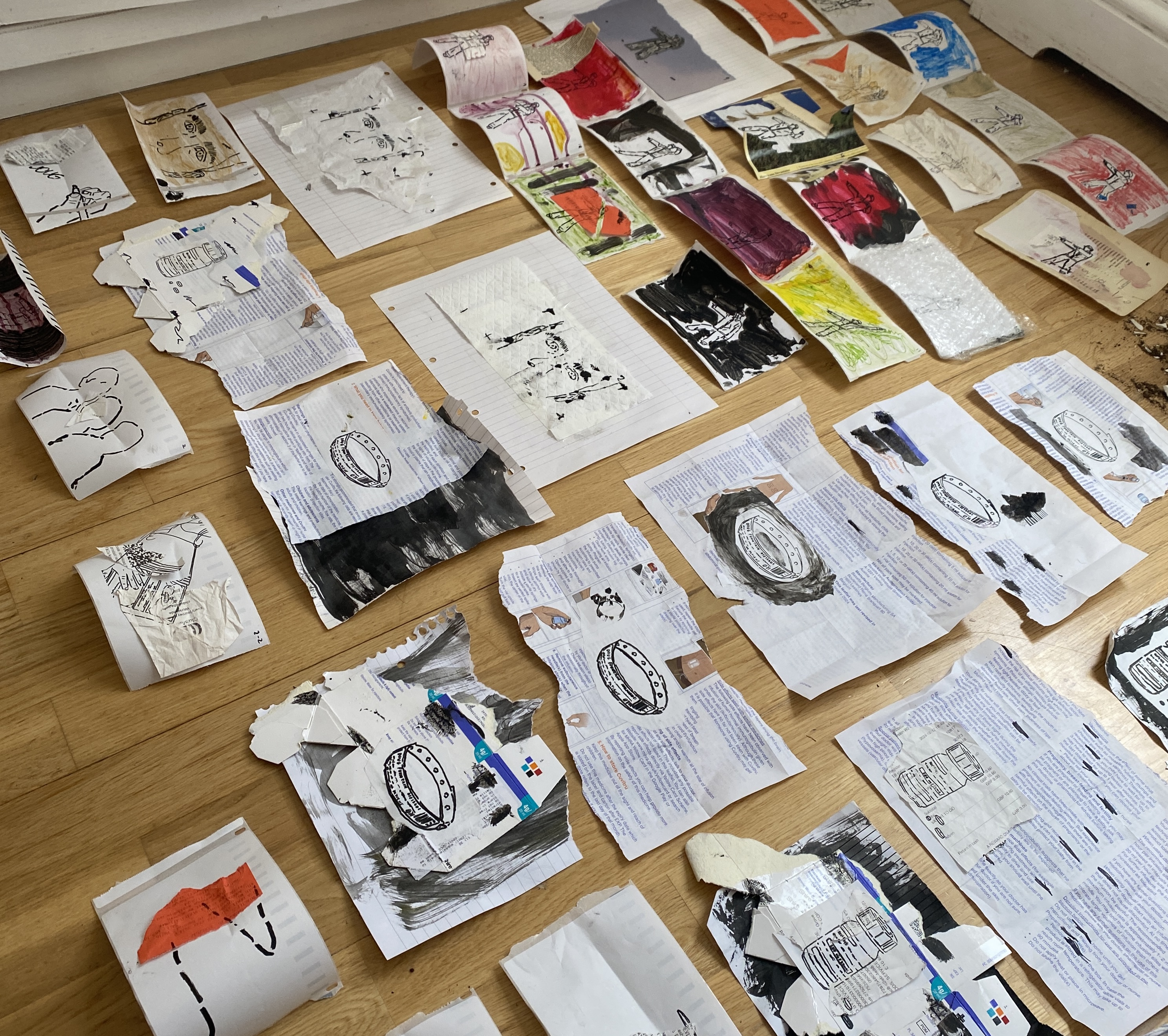
    Behind-the-scenes

    Can you describe your production processes, both in terms of interview and editing, and the creation of the visual material?
    For the initial development of the film, I did a lot of research into LGBT and AIDS history, especially around the time that Doug lived with it, because I had a really strong sensitivity to the fact that had not I lived through the AIDS epidemic in the 80s and 90s, especially not as a gay man with AIDS, even though I was telling a story about that specific experience. One of my biggest fears with the film was telling the story from too much of an anthropological-type outsider perspective in a way that felt like I was telling a story that wasn’t mine, and that didn’t give proper emotional weight to something that had impacted so many people, including members of my family, so incredibly deeply. My goal was emotional closeness, to make the viewer feel deeply and connect deeply with mine and Doug’s story, and so really getting myself acquainted with and knowledgeable about the subject matter was what I felt was the best way to avoid that distance. I actually read a lot about queerness and queer theory, too, to better understand and connect with my own queerness. And I did so much research into Doug, to find out as much as I could about him, to understand him as fully as I could in order to feel that I could tell his story in a way that he deserved. That included hours of recorded interviews, even though none of it actually made it into the final film other than a 5-second clip of me asking to hear about him. That was definitely not expected, but when it came to it, I just had no time to fit any of the actual recorded interviews into the film’s very short runtime, which is how the voiceover narration of Doug’s life and personality came about. I was very stressed about that limitation at the time, but now I think it fits the concept of the film quite well, so it ended up being a bit of a happy accident. From there, I wrote the script, which for me is always the load-bearing component of the film, and then all of the animation just sort of came along naturally from there, with very little pre-planning and largely as a very improvised reaction to what was there in the film’s narration.

    Behind-the-scenes

    In general, my production process is very messy. It’s a lot of thinking through making, and making decisions when I’m halfway through doing something, and inevitably changing the plan any number of times throughout the course of completing the project. I’ve tried to make my production process more streamlined, to start with a full storyboard and then a full animatic and then a full rough cut following an organised production plan that I set at the beginning. But for projects like this, where I don’t have clients and am not tied down to the amount of organization that working with other people requires, I find that I really like the freedom of working in such a disorganized, free-flowing way. I will make about ¼ of a storyboard, and then jump to making the animatic, and then jump back to working on a different part of the storyboard, and then jump all the way to making pieces of the final film and just not finish the storyboard at all. I plan what works for me to plan and just follow the flow of what I am inspired to do within the making of the project when it strikes me for the rest of it.

    For this film, I knew that I wanted a mixed media style that incorporated lots of archival materials and lots of tactility, but I didn’t know exactly what materials I wanted to use and what I wanted it to look like, and I didn’t want to limit myself by testing one technique and then forcing myself to only use that throughout the entire film. I am a very big overthinker and a very big perfectionist, and if I allow myself too much time to plan something, I can completely block myself from ever doing anything at all, and I wanted to just make without getting in my own way. I would say, “I think I want to try using collaged photos under inked linework”, and then I would make a shot using that technique, and that would be the testing, experimentation, and final outcome for the actual film all in one go. The experimenting came with very little forethinking and very much just allowing myself to make without overthinking it, which I think really worked for me and allowed me to discover amazing outcomes that wouldn’t have come into existence if I hadn’t allowed myself the openness of not having any rigid sort of plan. I think with all of my projects, the best outcomes are always things that happen when I have to change my plans midway because something ended up not working like I thought it would. Some of my favorite parts of most of my films have been things that weren’t part of the original plan at all.

    Did you have any breakthrough moments during the process of making the film?
    When it came to the scriptwriting phase of writing the film, I got very, very stuck. I had done all the research, conducted hours of recorded interviews, collected all the documents and photos and archival footage that I needed to tell the story, and suddenly I was at the stage where I had to turn that all into a real film. For my films, the script is everything – the true heart of what the film actually is, and everything else, including the animation, just sort of falls into place as a natural way of illustrating that story in video form. Because this film was so important to me in so many ways, I had so many expectations for myself for what this film needed to be, which put a lot of pressure on the final product. There were also just so many ways I could take the film, infinite possible films that could exist, all varying levels of better or worse than each other. Added on top of that was the fact that I had collected hours of interview footage and needed to fit that and the results of all of my months of research into the very small package of a 5-minute film. That was a huge challenge. I got really in my head about it all, and ended up being blocked for about a month.

    The breakthrough came when I started talking to other people about the script. Just talking through it out loud, hearing myself and thinking through speaking, I found that I immediately realized things about what the essential structure of the film needed to be, and what did or didn’t need to be included. I was able to draft a very imperfect version of the script, which I then took to a group of fellow filmmakers, and with their help, went line by line down the script shaping it into its final form. That act of seeking out feedback and co-creation from trusted collaborators in that phase of the writing process was a complete breakthrough for me, and is something I will be taking into the way I make all of my films from now on.

    Doug + Me, 2026

    Was there anything that happened in the film’s production, or in how it has been received, that has surprised you?
    I was wonderfully surprised by just how close the process of making the film made me feel to Doug, in different ways than I had expected. When you are making a film so centrally focused on telling someone’s story, you of course expect to get to know them and in doing so gain a sense of emotional closeness to them that wasn’t there before you began. I did get to know Doug in so many ways that I hadn’t before, and that was such a wonderful feeling to come to know more about this uncle whom I had never met but whom I had always known had had such an integral role in the story of my birth. But also, unexpectedly, I was amazed to discover so many little synchronicities that emerged during the process of researching and making and editing the film that connected Doug and my lives and experiences in such small yet profound ways. For example, I have a chronic illness, a Primary Immunodeficiency, and Doug died from a disease that is very much known and defined by its characteristic of causing immunodeficiency. There were so many strange little details like that one that came up over the process of researching, writing, and editing the film that felt each time like discovering another little thread tying us to each other. It was so beautiful and unexpected to discover them all, and to grow a sense of connection to him way more deeply than I had ever anticipated.

    What are your hopes for the film in terms of audience and impact?
    I hope, above all, that the film makes people feel something. When people tell me that they cried watching the film, that is the most wonderful feedback that I think I receive. When I was making this film, my goal was to tell a story that connected deeply with the audience, that people could watch and, in seeing this story, feel emotionally connected to and resonate with it, and with Doug himself. I have had people tell me that because the story is so specific and deeply personal to my own personal experience, they’ve found threads that they can relate to in their own lives, that they watch it and say, “Oh, wow, I’ve had similar experiences and feelings of losing a family member”, or “I’ve had similar thoughts about that”, and so on, and it’s been such an amazing experience to connect with people through that, and to have people connect with Doug in turn. In general with my films, I want to make work that communicates deeply human emotions and that, by sharing my own personal stories in a way that other people can relate to universally, creates a connection between myself and those who view it. In going into the creation of this film, the goal was to create that kind of story, and to create a portrait of Doug, a memorial of sorts, through which his memory can live on in a lasting, tangible way in the world.

    Do you have any advice for anyone who is interested in making an animated documentary of their own?
    Lean into the hybridity of the art form! There’s such openness in it. I think the beauty of the animated documentary is that it already breaks the rules, both of documentary and of what animation typically is. Be as creative as you want to be, and don’t let perceived rules of “what a documentary has to be” or “what an animation has to be” box you in and limit you. That’s something that was holding me back a bit in the middle of the process, and then when I released all expectations and internal rules of “oh, a documentary has to be this”, “a documentary has to do this”, that’s when the uncertainty fell away and I started making a better film because I started making the film most authentic to me and to my expression as an artist and as a filmmaker and as a storyteller. When you’ve already broken the basic rules of a medium, there is so much room and potential and freedom there for you to go wild with your creativity, free from any constraints of what any specific type of art should be. Lean into that as much as you want, make whichever film is asking you to be made, in whichever way best serves it, and don’t worry about the rest of it.

    What are you working on now/next?
    I’ve started working on the preliminary stages of thinking about expanding the film into a full feature-length documentary. There’s so much of this story that I collected that I was unable to tell in the very short runtime of this 5-minute short film. There’s so much of the context of AIDS and LGBT history in the 80s and 90s, and so much content and so many beautiful moments within the interviews I conducted that I didn’t include in this original short but that I think deserve to be told in a much larger, all-encompassing piece. So I’m getting in motion the early stages of beginning that much larger undertaking. I also have a new short animated documentary that I’ve begun thinking through, about the 1945 accidental crash of a military bomber plane into the Empire State Building, and my great-grandfather’s experiences with that. He was working on the 79th floor when the plane hit the skyscraper, and died after helping his colleagues out of the building. It’s an event that has had such huge ripple effects on the fabric of my family’s history but that has been little examined, both within my family and in the larger context of general history, and I really want to tell that story. I’ve just begun some preliminary animation experiments and research on the topic, and like with Doug + Me, plan to explore that larger piece of history through the lens of mine and my family’s own personal experience.

    Doug + Me, 2026

    You can follow Cecile Fountain-Jardim’s work on Instagram and on her website.

    Interview by Carla MacKinnon.
  • The 2025 feature-length animated documentary Endless Cookie is a wonderfully weird, warm, and thought-provoking portrait of the family and community that surround the film’s two directors, Seth and Pete Scriver.

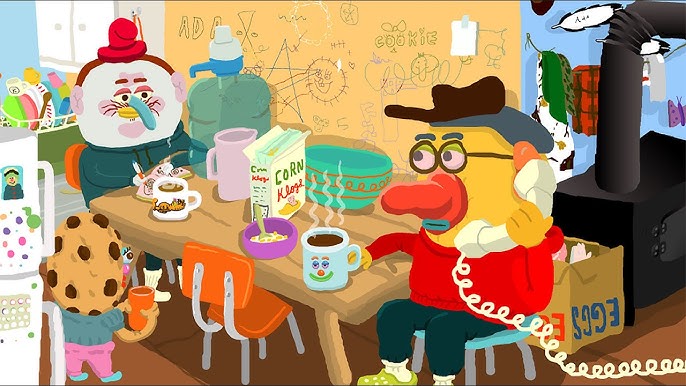
    The film’s structure meanders through stories told by Pete, anecdotes from his own life interweaving with local legends from his home in Shamattawa, a remote First Nations community in Canada. These stories were recorded and edited over nine years by his Toronto-based half-brother, Seth, who then animated the scenes, creating a colorful, surreal world in which humour, care, spirituality, and everyday eccentricity sit alongside tragedy, social injustice, and occasional horror. The colourful design balances the cute with the borderline grotesque, building a captivating world unlike anything you’ve seen before.

    Endless Cookie premiered at Sundance and won the Contrechamp Grand Prix at Annecy, the Rogers Audience Award at Hot Docs, and Best Feature Documentary at the Canadian Screen Awards, among other accolades.

    I had the pleasure of chatting with Seth and Pete Scriver about film, and their production process. You can listen to our conversation on the podcast, or read the transcript below.

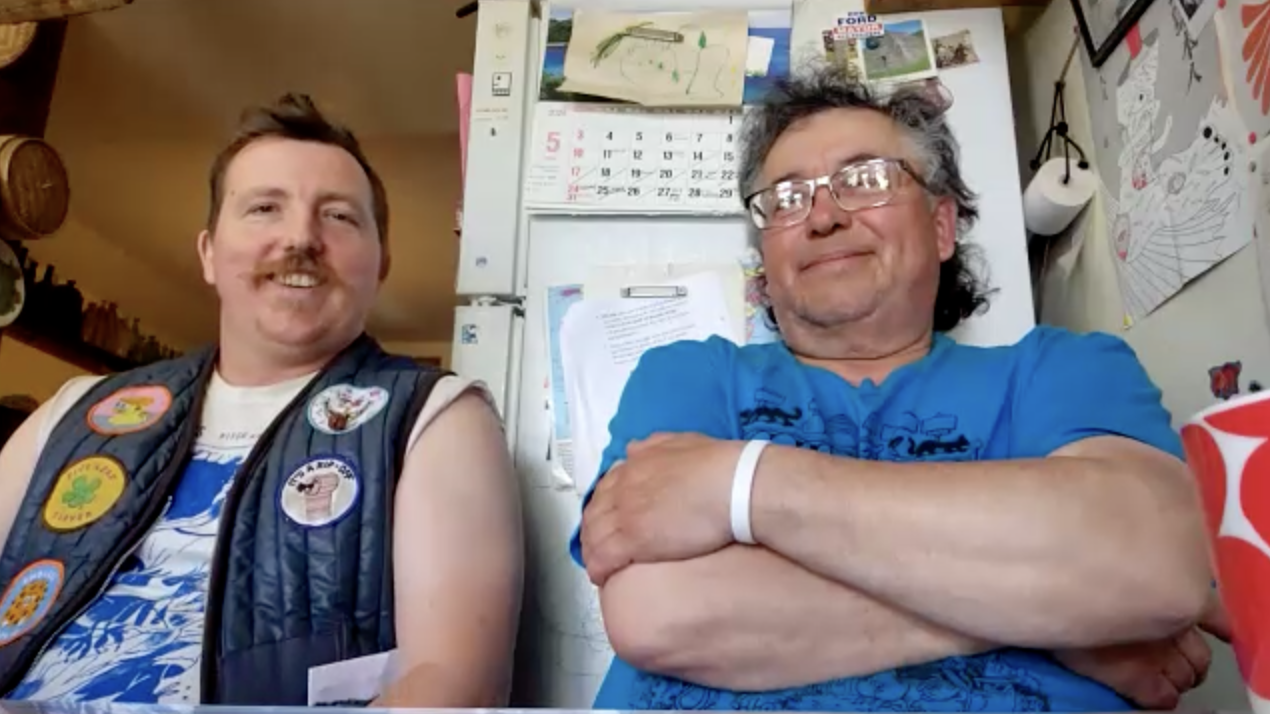
    Seth and Pete Scriver in Toronto, photographed in interview over zoom, May 28, 2026

    Interview transcript

    CM: How are you doing? 

    SS: Doing pretty good. Pete’s usually up north but he’s down visiting because we’re going to an awards ceremony tonight

    CM: The film’s been doing brilliantly. 

    SS: Oh, yeah. It’s been amazing. Way crazier, way better than we thought. 

    CM: I absolutely loved it. 

    SS: Thank you. 

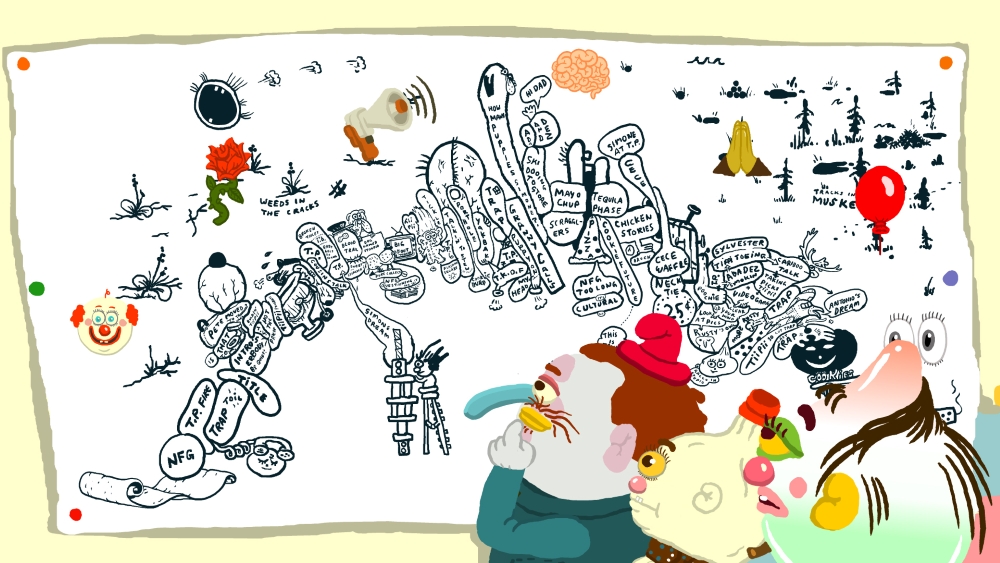
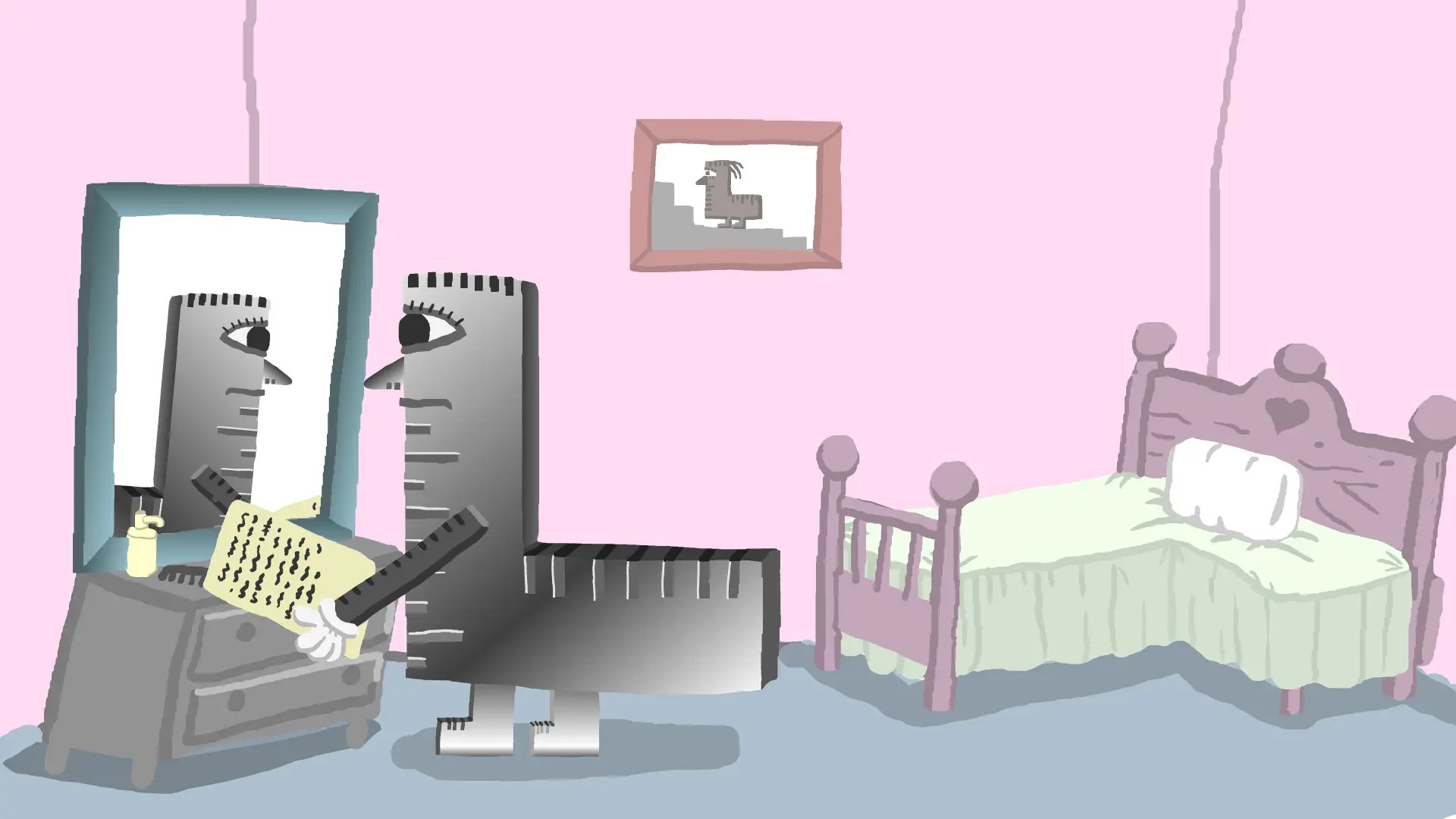
    CM: The film opens with this right-angle shaped guy who’s going to fund your film. From the “NFG”. 

    SS: That’s a carpenter joke, I work as a carpenter when I’m not animating, and we call that a square. So he’s literally a square. NFG is just a made-up funding body, it’s a joke on us because NFG stands for No Fucking Good. It’s what they write on tires and stuff like that, when it’s like they’re going to throw them away at the auto body shop – NFG. But then the big funder of animation and documentary in Canada is the NFB. You know, it wasn’t meant to be any kind of diss on NFB. I actually really loved the NFB but, you know, we were talking to them at one point and nothing ever happened, which is no big deal. Obviously we got money from other people. But it was funny because people thought we were dissing them. But we weren’t trying to, we were trying to make fun of ourselves. 

    Endless Cookie, 2025

    CM: So you had multiple funders. So this character of the main funder is a more of a device?

    SS: Yeah, exactly. Some of those questions, some of his comments were real comments from producers, or from Telefilm or whatever, along the way. So it was a funny tool. It was kind of terrifying to make fun of the people giving you money, but then it worked great. At one of our first Canadian screenings there was some grant officers in the audience. I asked them, “what did you think of that?” and they were like “that was my favorite part”, they were like “I just like to be seen”. Which is really sweet. 

    CM: You presented him quite sympathetically as well. Like he’s asking, “why is this scene going on so long?” And you explain to him why it’s important. And he’s like, “oh, that’s very interesting. Okay”. 

    SS: Yeah, that was a real question. It was like, why is this ridiculous scene so long? And then it was trying to justify it basically. 

    CM: For me, something that was effective about the film is that so much of animation often just seems to be about efficiency, but there didn’t seem to be any efficiency – it was so meandering, so huge. 

    SS: I would not recommend taking the route we took. For us, it was the perfect thing because it allowed us to be more open with our storytelling and with where we went because we really went all over the place and we didn’t plan to go all over the place. The original plan was literally just telling a few stories to cover life in Shamattawa and then also a little bit of stories from Kensington. And then, sure enough, Pete lives in a four bedroom house with eight kids. And at the time, I think there were sixteen dogs. And then it was like…

    PS:  Twenty-six, twenty-six dogs. 

    SS: Yeah. Because the puppies too. And the noise of the puppies under the stairs, that was a real noise. We were trying to figure out what it was and it was right beside us, on the other side of this thin wall. All these puppies were born and making this high-pitched squealing noise. 

    PS: We tried to be professional at first and it was like record, then stop, record, then stop. Because all of a sudden you realize you can hear the clock ticking on the recording, and the fridge. 

    SS: Yeah. Over the nine years of recording, we have audio documentation of Pete’s fridge becoming, like, unbearably loud. But, yeah, in most animations obviously you have a big plan, you set up the plan, and then you do the audio recording first, and then you animate to the audio recording. Ours was like having a plan and then the plan totally getting screwed up, and then the audio leading the movie and then editing it once we kind of had the whole thing together. The movie was originally two hours long. It just hurt your ass to watch. And it was painful because there’s a lot of beautiful things that we had to cut out, but we ended up cutting out half an hour, and then I showed it to Pete, and Pete didn’t even know what we cut out. He’s like, “I don’t even notice the difference”. 

    CM: Was that half an hour of complete animation you cut?

    SS: Yes, that’s the insane thing. So I probably animated for an extra year, but it’s great because we have those. Tonight we’re showing the film a couple hours away from Toronto and they’re going to screen a couple of the outtakes after the film, which are really funny little scenes. We’ll put them on the DVD or Blu ray or whatever or put them online at some point. Like bonus stuff. 

    CM: I did have a question then about this long period of making – it nine years, I think? 

    SS: Something like that. I keep forgetting.

    CM: Animation covers so much over in terms of how things are made and how that fiction /  non-fiction process works. There’s bits of the dialogue that feel definitely like spontaneous interview, and then there’s bits that feel definitely scripted, and then there’s quite a lot where you just can’t tell. 

    SS: Pete has a beautiful way of describing the way we recorded the stuff…

    PS: Real situations, like conversations around the kitchen table where you have your family discussions and it’s not supposed to get recorded. That’s kind of what had happened. 

    SS: No one was actors. So we would just keep recording and recording and recording and capturing things, and sometimes I would go back into recordings to try and find something, and then I would find something I didn’t even realize we recorded that would be beautiful and make it into the movie. Like me encouraging Cookie, when I called Pete one time, I didn’t even remember any of that. I was like “oh, this is so sweet, we gotta put this in”. But a lot of the time, in a normal situation when you’re talking with family, there’s a lot of things that aren’t in context. We know all the contexts around every story and every person, right? And histories of First Nations and history of Canada. Our family usually has a grasp on it. And then we would realize when showing it – “oh shit, maybe people won’t understand this”. And definitely if it’s about our personal family stuff we gotta add context. And so that was one of the things that became scripted, but it would be usually scripted from something someone said before, so it would be a real thing, but then we would have to rerecord it because it just wasn’t in there, and we needed lines to make sense. And so those were generally the scripted parts. And then sometimes we would have other parts that were not done by family members, just to give context for a different story. Like the NFG officer, he would ask a question that could lead to context. We wanted it to be understandable, but we also wanted it to be loose. So that was a funny way to try and do that. 

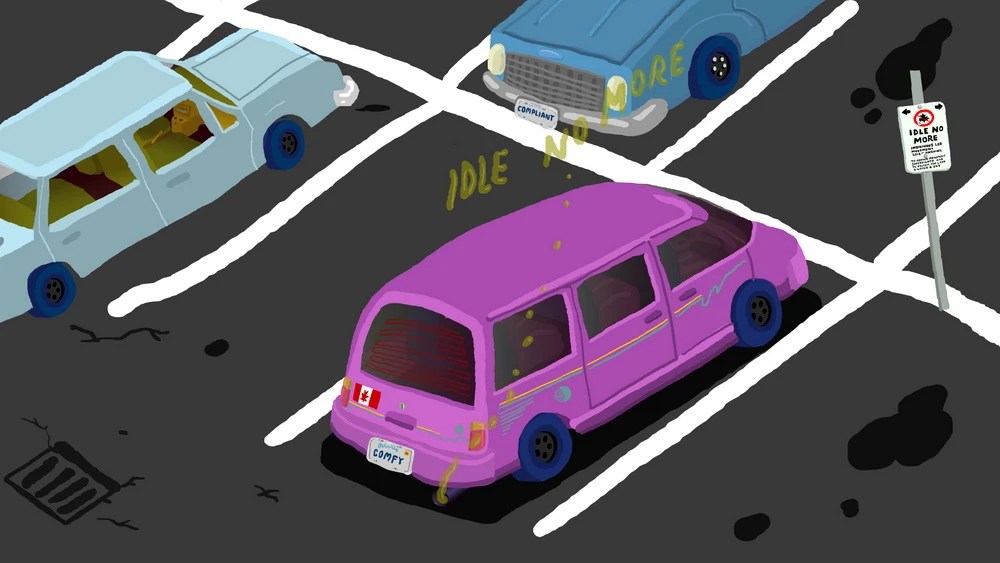
    CM: I’m interested in the social politics side of it which keeps on pushing through. One of the sequences I loved was the comfy car seats in the idling car. You become very aware of yourself sitting in your seat and watching, when you’re watching the comfy car seats. To what extent do you want to make an audience critically aware of their position and reflecting on it, or how much is that just a joke? 

    SS: That joke of the car seats idling was about a native movement in Canada – a really powerful, popular movement. We worked on the movie for so long that that movement is a smaller movement now, but it was really big when I first started working on it. 

    PS: It was a very powerful movement. 

    SS: It was called Idle No More. And so that was the opposite of Idle No More – just idle. And then it was like, “who are the people that are idling?” and it was like, “oh, you couldn’t be more idle than actually sitting, idling”. Then the joke went further and it was like, the actual like car seat. It was a beautiful, surreal thing. I’m thankful people love that scene, even if they don’t know the Idle No More movement.

    Endless Cookie, 2025

    PS: It was a movement that started after the Oka crisis back in the early nineties or late eighties. They had a standoff with the Canadian government. They were trying to move graves to convert the land to a golf course. Idle No More came out after that. 

    SS: There’s a great NFB documentary by Alanis Obomsawin about that event. And then Idle No More was this movement and one of the leaders was having a hunger strike on the Parliament Hill. And the Prime minister at the time decided to, instead of meet with her, he like went to a zoo to cut the ribbon for panda bears, or something ridiculous. 

    CM: Pete, your involvement with the film, on screen, seems to start with a phone call. At that point of getting the money to begin the film, you guys had talked about you telling some stories, and that would be a spine for the film. Did you know more than that? 

    PS: I didn’t know it was recording. 

    SS: I cold called, and then at the end, I was like, “I recorded that”. Just so that he would be loose and it would be a real call. But I came up earlier. That phone call, that became a different device for the movie. Because I would interrupt his stories all the time. And it would just be like, “how do we deal with this terrible recording?” And I was like, “oh, I could just put myself there, and then we have the microphone”. That was one of the things that saved us, just deciding to show that we’re making a movie, to be transparent about everything. 

    PS: Yeah, it was just impossible to cut out all the background noise, and it just became incorporated. 

    Endless Cookie, 2025

    CM: About two thirds or three quarters of the way in, we suddenly start seeing photographs of the real people, which has such a weird effect, having got used to the animated versions of them. 

    SS: My friend Aaron suggested that. He was like “you know, people probably don’t even realize that that your family is real. You should show real pictures”. And so that was kind of what spawned it. But it’s also nice to put it in kind of far along because by that point, they audience have been convinced that we’re real, but because the characters are so weird-looking they’ve put part of their judgment in a different section of their mind. Like “okay, I’m just gonna release this part of my mind and just say that this is real and this is what the way they look”. And then we show the real characters. It works really well. And it was fun because we had all these amazing photos.

    CM: So that roots things in the reality. But then there’s also this spiritual side, the sleep paralysis and the dream of the elders, and these heightened realities. I felt like the animation let the reality and the heightened reality sit together, meld into one world. But did that come out through the process or was that always something you wanted? 

    SS: It came through the process. But that’s just a real situation up north in Shamattawa. And people like Pete’s stepmom, and my mom, she loves to talk about dreams. So it’s on both sides of the family. It’s actually a really common topic, but especially in Shamattawa, I think, with the kids and stuff. A lot of them have really wild dreams and visions and stuff like that. So it was nice. I’m happy that it came up because it was important. We have to include this stuff. 

    PS: When they first told me that it was a documentary, I was like, “what? It’s a documentary? How could that be?” 

    SS: Oh yeah. It’s funny, when we were finally done, we were both trying to figure it out because when you apply to film festivals, you have to apply to a category. And we hadn’t thought of it until then. And we were like, “what is it?” And then we were talking about it for a while. And then it was weird. I remember when we were like, “I guess it’s a documentary”, and you know, it really is. But it’s hard when it’s about yourself. It’s easy to forget that. 

    CM: Was there any point where you just felt completely lost in the process of making it? 

    SS: Oh, yeah. For a few years, it was like, “oh my God, like, what is happening?” We could always kind of see the curve of it, but putting it all together, it didn’t always flow. And then it took so long to animate because there wasn’t tons of money. I had an animation assistant for three months. And then, over the rest of the nine years, we only had enough for me and then it’s like, you can only abuse yourself up to a certain point to not pay yourself properly. There were lots of moments where it was so much work and it was so daunting looking at the storyboard. And it would just be like “okay, I gotta work a little bit every day and then eventually it’ll be done”. And then it started to be like “oh my God, why did we call this Endless Cookie? Did we curse ourselves? It’s just going to take forever”. That was the joke in the film about it being after the end of the world, and I’m still working on the animation. 

    CM: I love the bit where Cookie says “oh yeah, I was just like a baby when you started this, and now I’m ten”. 

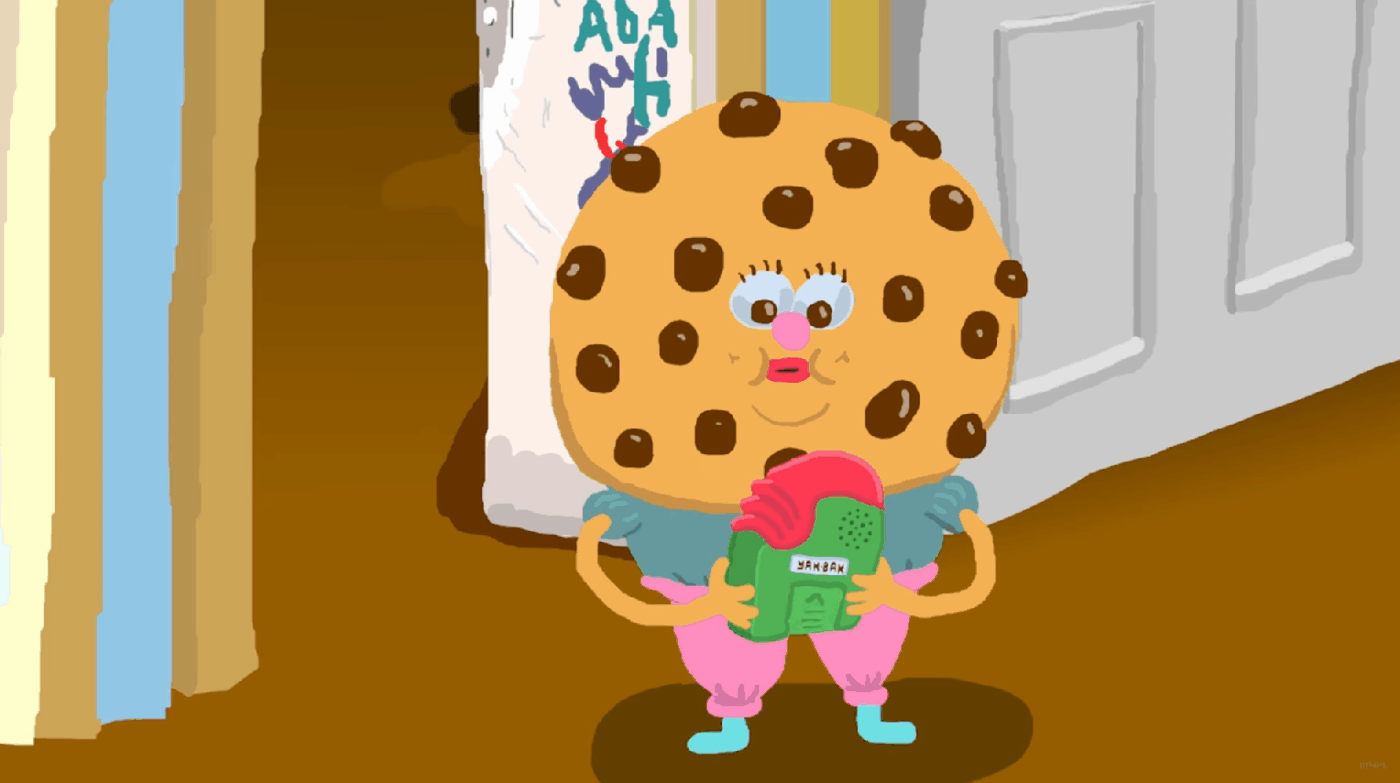
    SS: It’s pretty sweet how Cookie kind of came around to that, because for a while she liked her character, and then when she was twelve or thirteen or fourteen, she was kind of like, “why am I a cookie? Chris’s character is so cool. Why am I a cookie?” And then by the end, when now she’s nineteen, she’s like, “I like my character”. So thank goodness it took so long.

    Endless Cookie, 2025

    PS: I got a call one day from the producers. They had started wondering if this was for real. I hadn’t talked to them, they were dealing with Seth the whole time. So three of us went on a three-way call. And I totally forgot about the producers. Me and Seth started talking about an idea. I basically just broke out into a story. All of a sudden the producer is saying “okay, okay, that’s fine, sounds great”. 

    CM: Did you do an audio edit first and then the storyboards based on that, or was it simultaneous? 

    SS: Most would be audio first. I would just kind of compile a little bit of audio and then animate to it and then see how it flowed. And then sometimes there would be a bit of extra animation and then we could add audio to that. But most of the time it was dealing with the audio first and then animating. And then going back and forth. 

    CM: Would you finish a scene without necessarily knowing what’s coming before or after?

    SS: Most of the time we actually kind of had a plan of the way a story is told and the way story flows, like in in real life around the kitchen table. And so there was a kind of pathway of the chaos. Like, when we gave into the chaos, it was kind of like we were being led. Like the joke about looking at the storyboard, I think I say like, “I’m not sure if the storyboard is leading me or if it’s following me. It was kind of like we were being led by the interruptions and all the other stuff. 

    Endless Cookie, 2025

    CM: Would you have any advice for any filmmaker trying to like scale up to making longer form animated nonfiction? 

    PS: When I was in grade seven doing writing, the teacher told us that the best thing to do is to write what you know. So that’s basically our whole movie. I told stories that I knew, I didn’t make up anything. I guess I was comfortable with just talking and Seth recording. And a couple of times I thought “hey, how come is he looking at me like that?” I guess it just depends on the story. 

    SS: One of the good byproducts of the movie taking so long was that Pete would tell an amazing story, and then he would be like, “oh yeah, don’t put that one in the movie, I don’t want the kids to hear it, they’re too young to hear that story”. And then luckily they grew up, so we could put a couple of those stories in. 

    CM: Will you guys be working on anything else together? 

    SS: We have some plans to. We gotta figure it out. We have too many ideas. We gotta narrow them down to, like, two. We weren’t that organized, and I think we’re going to try and be a little more organized this next time around. But you know, we’ll probably end up being loose again because it’s just our nature. 

    PS: He did most of the work. I just did the talking. 

    SS: Well, you know, it wouldn’t have been very good if Pete wasn’t talking. 

    CM: Well, thank you so much for making the time to talk to me. 

    SS: No problem. Nice to meet you. 

    ___

    Interview by Carla MacKinnon

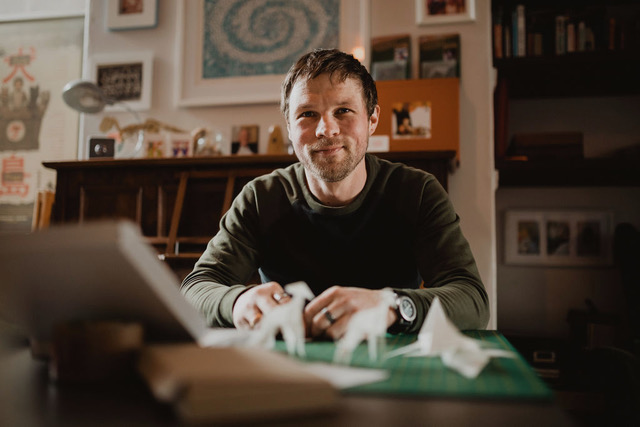
  • James Pollitt is an artist and facilitator whose animation practice focuses on the use of restricted or repurposed materials. He often uses crowdfunding and crowdsourcing, selling replica puppets and merchandise, encouraging audience engagement and giving supporters chance to input into projects. Here, Pollitt discusses his recent short animated documentary Dog Crease Pattern.

    What was your motivation for making the film?

    I used to have two whippets who inspired my model making and animation work in many different ways. I found their stylised shape, exaggerated movements and personalities a constant inspiration. Penny and Eric weren’t my first pets by any means, and I have always found the ephemeral nature of pet ownership interesting – how does it change how we view time and our own mortality as people?

    While my whippets were alive, I challenged myself to design an original origami model based on them. I like origami and had designed a couple of other models previously but didn’t have a clue how to do it – I do not have the mathematical approach and the work of people like Robert Lang blow my mind. I just experimented around with the forms in an instinctive experimental way. After my whippets passed away I wanted to revisit this model and make a short film of some sort, to bring this model to life properly. I decided early on I wanted this to be a ‘one shot’ style animation with each sequence following on and blending into the next, melding time and experience. I was inspired by Visible Mending by Samantha Moore (among other things) and decided to use other peoples stories to form the narrative to which I could animate. I wanted to use real voices and really liked the idea of different accents and genders having unique yet relatable experiences to the subject. 

    What was the process of collecting and organizing/editing interviews for the film?

    I ran a Indiegogo campaign where backers of the project were invited to answer a survey relating to their experiences of dog ownership and loss. Over 15 people sent in answers leaving me with 4000 words that needed editing down and composing into a narration. An added challenge was that I wanted each person represented multiple times throughout the piece – I hoped there would be a nice selection of genders and accents, and I wanted these to be scattered across the film. I colour coded each person’s content so I could keep track. 

    I decided early on that I wanted to have the narration loop back to the same place it started, to represent the often-cyclical nature of pet ownership i.e., how the last pets are often on your mind when you get new ones. I edited the survey content down into interesting quotes which I then started bunching together into ‘themes’ – such as: getting 1st dog, tricky starts, illness etc. I did very rough sketch ideas of which animated movements I could use to illustrate each line. The sketch, words and colour coding were put onto small cards which could be arranged and rearranged. during this process I found lines that said similar things and sometimes combined them or left out. During this process I always had in my mind the visuals and how they would link. I had timed how much 4 minutes of talking was (in a word count) and aimed to get my narration to 700 words. 

    Thankfully, nearly everyone who got involved was happy to send me voice recordings. The two people who didn’t want to send their voice were happy for a stand in to take their place. Everyone did so well and I was really happy with the responses. I needed to use some audio software to level out the recordings as they all had different echoes, tinniness, bass etc due to no control over how and where they were recorded (people just recorded from their phones in whatever room they were in). I think my efforts on Adobe Audition worked well and they all sound consistent. At this point I arranged all the audio files in order.  I decided to tweak it further now I was hearing it out loud and could judge the pacing better. I edited out a bit more content as I wanted more pauses at certain points. I wanted the film to run for under four mins and was able to get the narration to this length. 

    I timed each narration segment individually, so I knew how long I needed to animate to. I took the initial thumbnail sketches and began turning those into a more realised storyboard. This was tricky as I wanted each sequence to flow into the next without obvious cuts. I wanted to use a few visual styles; Origami being folded, dog movement, paper shapes and illustration formed by fold lines on the page. I wanted these to be evenly spread across the film. When I had the storyboard with all the timings I made a photo animatic (a very rough low frame rate animation) with some mock ups of the physical elements. This further allowed me to refine the timings to make sure that each movement was possible within the time. I cut this animatic into 50-ish sections with a frame allocation for each section. I then began animating properly, following this animatic closely but also allowing myself to make creative or practical adjustments along the way.

    What challenges were there in the technique you chose to you? 

    It was challenging to make stop-motion with paper. The models (and parts of models) needed changing regularly, as the feet (which had pins in them) would tear, the tin foil joints would wear out, the paper would get grubby from finger grease etc. I made around 50 models, maybe more.

    I wanted to make the set up as close to white as possible which was difficult without bleaching the models – so I decided to edge the paper and emphasise the folds in black. This might not seem like a big thing, but I also didn’t want there to be any shadows on the back wall of the set (I wanted the illusion of an open clear set). This was impossible because my studio is so small, and the puppets had to be close to the back, which cast a shadow. To fix this I edited every frame with a clear background. This took ages but it was important for the final look. People won’t notice it (!) but if the shadows were there it would be distracting and messier.

    Planning the storyboard and animatic to specific timings was helpful. Even so, making specific movement with a specific frame allocation whilst still looking natural enough was challenging throughout. 

    What are you working on now/next?

    My animation M.O is to use restricted or repurposed materials, and I spent many years working with a dog design made from toll box items. This project is called Whibbits and I sell replica models and merch to help fund the projects. I am about to launch a fundraising campaign to make a new Whibbits animation using a new ‘rusty’ style model. I hope to sell five models and some pin badges to help bring this project to life. I will get audience input to this new project by asking people to send videos of their dogs for me to use as reference. 

    Another related project idea is another origami animation. I have asked Robert Lang if I can animate some of his designs and he has given me permission. I’d like to do a grey whale folding process video followed by an effect of the model splashing in and out of water. I also have a long term project that is always in the back of my mind that uses a puppet made from found objects from my late nan’s flat. This project would be huge undertaking. The design, research, planning, and execution would need serious funding. If I ever did this project I would like to use real stories and voiceovers, similar to the Dog Crease Pattern process.

    _

    You can follow James Pollitt’s animation work here.

    Interview by Carla MacKinnon

  • Sheila M. Sofian’s animated documentary films have played at festivals including Annecy, Ottawa, Hiroshima, and Zagreb among many others. Her work includes numerous short films as well as the hour-long animation/live action hybrid documentary ‘Truth Has Fallen’ (2013). She received her BFA at the Rhode Island School of Design and her MFA from the California Institute of the Arts. She is currently a Professor at the University of Southern California where she has been teaching since 2006. We interviewed Sheila about her work, and changes she has observed in the field of animated documentary over the course of her career.

    CM: How did you first come to documentary filmmaking?

    SS: When I was at undergraduate school at Rhode Island School of design, the degree we had there was film, video, and animation. We were required to take both film classes and animation classes. So I took documentary as well as animation there, and I loved the documentary class. And then I made my senior film, ‘Mangia!’ which I didn’t consider to be a documentary at the time although now looking back on it I have mixed feelings about that. It’s about living with an Italian family so it’s based on my experiences.

    CM: It reminds me a little bit of John and Faith Hubley.

    SS: I was influenced by the Hubleys, as well as Caroline Leaf and other people. So I gravitated into it, but before I did my animation degree I was studying a lot of social science and that merged a lot of my interests – the social science, documentary, and animation. And I just followed a direction that felt natural. It wasn’t really a thing at that time, so it wasn’t until later that I started hearing the words ‘documentary animation’ and that was kind of exciting because you could see that was becoming more of a reality all round the world.

    CM: At that time was the work primarily considered documentary or animation? 

    SS: At that time it was just “animation”. There were a couple of other people that worked in non-fiction animation and we always felt kind of like second class citizens at the animation festivals because they were more interested in, you know, the craft of animation, squash and stretch, whether it looked beautiful, whereas we were concerned about content. So my films were actually performing better in regular film festivals and not in animation festivals specifically. But then over time that’s changed, there’s been more specific categories for animated documentary, and it’s been elevated a little bit more in status.

    CM: And in terms of techniques that you were using, were they driven by the subject matter or driven by commissioning requirements, or other factors? 

    SS: I like to think it was driven my the subject matter because I think that especially when you’re dealing with memories, painting on glass works really effectively. And also for my film ‘Truth has Fallen’ – where I worked with both live action and animation – I felt that painting on glass could carry the weight of the live action more. If I cut back and forth to drawn, it would have been too dramatic of a switch. So that was one of my reasons for choosing painting on glass for that film, I felt that I could match the tone better. 

    CM: Was ‘Truth has Fallen’ difficult to get made?

    SS: It took me a long time, it was hard to get funding, but in some ways it was good that I didn’t get as much funding as I had originally wanted. I was planning on doing more live action and I think it forced me to do more animation, which worked better in the long run. The live action was a big hurdle for me because I hadn’t worked in that way, so I had to work with a big crew of people and all the logistics that go along with that. I really wanted to push it to look more like the animation and I think I would have worked harder to do that, if I were to do it again. It was a learning experience, I learned a great deal. 

    CM: So actually to design the live action sequences to mimic the animation?

    SS: Yes, I was trying to approach it in the same way as I approached the animation, and I was thinking of the people being more like puppets. I worked with a lot of extras and of course they wanted to be more dramatic, and act, and I was trying to control them. Animators are controlling, you know, we like to control the whole world that we’re working in. You can play God and you don’t have to worry about anything else in the frame, you can make all those decisions yourself – but with live action there are things out of your control.

    CM: One of the things I find interesting in animated documentary is the tension between the dynamic spontaneity that can come with documentary, set against the tight control that an animator wants, and how that balance happens. Did you find any challenges around working with a live action crew? 

    SS: I was working with a professional crew of about twenty people, and I had three locations: I had the stages at USC, I had an abandoned prison, and I had a courthouse in Orange County. So there were all the logistics in terms of licensing, generators, security, catering… I had a good team of people I worked with, I had a great production manager who had a lot of experience, I had a DP that I met at a film festival and he helped me get a lot of the crew like gaffers and all that. What was great about him was that even though I was inexperienced, he would pull me aside, away from the crew and tell me how to approach things differently that I wasn’t aware of, or the etiquette on the film set. What was interesting about that film shoot was that the crew were so used to working on these horrible movies, b-movies, and they were really excited about working on something that had meaning. They weren’t used to artsy films so they would say things like “oh the artsy shots”, but then they started getting into it and making suggestions, so they were getting more and more invested in the film as time went on. So it was really a fun experience, it was a large group of people, but it was good. But I kind of prefer the solitary working alone by myself in animation, rather than having all of these variables and all of this organisation and so much to worry about with live action. 

    CM: And then you’re also working with interviewees? 

    SS: Yes that was a whole other ballgame. I got a Guggeheim Fellowship which allowed me to travel with a producer who opened doors for me, I got some good names to interview because of her, as well as my main subject for the film, who introduced me to his clients so I could interview them. We travelled all over the United States interviewing different people, and that was really fruitful. 

    CM: How was the film distributed?

    SS: It’s hard because distributing a feature length – featurette, 1-hour film – is different from shorts. I worked through an agent and he got it on Los Angeles public library system and other public libraries around the United States where you can stream it for free, and also it’s on Amazon, as a DVD. 

    CM: What was the budget?

    SS: The production was more than ten years, and from the inception it was more like sixteen, from the first interview that I did. And the budget was about $100k,  but that doesn’t really include all of my time. I did approximately 20,000 paintings, all the animation was just me, I didn’t have anybody else help with that. But most of the money went directly to paying other people. 

    CM: In your work there are often political and ethical themes. Is that inherent in your work and who you are as a filmmaker, or has that come through the commissioning opportunities that there are about? 

    SS: None of them have come through commissioning, it’s all been work that I’m drawn towards. What excites me the most are human rights oriented films – I’m interested in making something about immigration, or a personal story. I’m really interested in ideas of good and evil because I think there’s no real such thing, I think everybody has some of both, and I’m interested in interviewing both scientists and people that have committed atrocities and learning more about that. So that’s something that sort of drives me. I think that we all tend to think of people in those terms – good or evil – but really we’re all complicated. 

    CM: How have your short films been funded? 

    SS: All grants and self-funded. It’s not that expensive for me because I’m doing all the animation myself, but music and post-production – the sound mix, compositing, that’s where the money comes in. I’ve been able to get grants here and there so that’s been very helpful. The places I’ve taught often offer faculty grants that I’ve been awarded, so that’s been helpful. 

    Can you talk about your most recent short film, ‘Disabled: A Love Story”

    ‘Disabled: A Love Story’ is an animated documentary exploring the effect multiple sclerosis (MS) has had on the lives of Terry, now a paraplegic, and her husband/caregiver, Jon. Using audio interviews and expressionistic animation, Jon and Terry describe their difficult journey. Beginning with the diagnosis and continuing through their +35-year marriage, Terry struggles to continue working as a city planner and teaching at MIT while losing her mobility. Jon works as a writer, and together they learn to adapt to each stage of the disease.

    As the MS progresses, Terry grows more dependent on Jon. Despite her worsening condition, until recently Terry continued teaching. Jon’s care has made it possible for her to continue working throughout her advanced stage of MS. Jon and Terry describe the emotional and physical toll the disease has taken on them and their relationship. 

    The use of animation allows the audience to empathize with Terry without judging her based on her appearance. The digitally drawn animation and smeared colors create an intimate representation of Terry and Jon’s experiences. Images depicting the situations being described provide an unfiltered look into their circumstances from their point of view. The soft color palette and fluid transitions reflect their heartfelt testimony, capturing each event with intimacy and candor. 

    What are you working on now?

    ‘Undertow’ is a documentary animation that explores and visualizes personal experiences of anxiety, depression, and anger through the medium of painting-on-glass animation. Using recorded interviews, I interviewed several people about their experiences with these conditions and asked them how it felt, what it looked like, and how it affected them.. These testimonies serve as the foundation for the abstract painted animation.

    Using an analogue painting-on-glass technique, I will animate abstract forms that visualize the testimonies. The fluid nature of this medium allows for spontaneous expression, capturing the internal turbulence  and emotional intensity described by the interviewees.

    CM: Would you do another long-form animated film?

    SS: I don’t want to do another hour-long film again, but of course never say never. At this point shorts are more manageable, but it depends on the material. With ‘Truth Has Fallen’ I felt it had to be longer to get the information that needed to be in there. So, it depends on the quality of the information I get and if I can make it work in a short film, or if it needs to be extended. 

    CM: Do you teach documentary and animation to your students?

    SS: I have been teaching a Documentary Animation Production class since 2010. In this class we study documentary animation films made around the world and the students collaborate on a film. I then enter the finished films in film festivals. Some of them have done very well – you can view the films here.

    When I’ve taught production courses before they’ve been more of a studio model where you’d had one director, an animator, a designer, etc. But the way I’ve taught this class is that everybody is an independent filmmaker so every single student is the director. It invites chaos, but at the same time each student gets to try every single step of production, from choosing the story to transcribing and editing, and the actual animation. So they all have to participate in every part of production. 

    CM: Do you feel that documentary animation is picking up momentum? 

    SS: I really do. I think there’s just a bigger desire for social justice and activism in general, so I think that probably has something to do with it too.  When I was giving a workshop in Colombia, they were excited about animated documentary because it was dangerous for them to do live action documentaries, but animation was a way for them to express themselves in a safe environment. As far an animated documentary here in the US, I think it’s a way to use your art to express yourself and I think people who are animators are drawn towards non-fiction to express themselves. As artists and filmmakers and animators we want to be able to use our craft to express ourselves and make something that’s about something. Not that fiction can’t be, but I think documentary… there are so many voices that need to be heard.

    CM: In terms of the other work that you see, have you noticed there being changes in animated documentary trends?

    SS: I do see more varied techniques such as stop-motion and CG. I’ve seen much more cutting-edge experimental documentary. People are pushing boundaries more and more. Animation can affect you in a different kind of way – where the imagery is so powerful that it kind of shakes you up.

    CM: Animators take a different approach to documentary storytelling.

    SS: And there is value in both. When I was at CalArts experimental animation, they didn’t really tell you HOW to do things, you operated more in a vacuum, but in some ways I think that’s better. When you don’t know what the rules are you invent your own rules, and you can be much more creative – you can fail but you can also hit the truth in extraordinary ways that wouldn’t have been possible if you confined yourself in a box. So I think that it’s exciting, especially when you see films from countries that don’t support filmmaking in general – people inventing it themselves, and creating their own language.

    ___

    ‘Truth Has Fallen’ can be watched in full here. You can find out more about Sheila M Sofian’s work on her website.

    Interview by Carla MacKinnon.
  • In the new episode of the Animated Documentary Podcast we talk to director Rosie Schellenberg. Rosie has over twenty years of experience making award-winning films and television programmes. Her latest film, Turner: the Secret Sketchbooks, broadcasts on Wednesday 19th November at 21:00 on BBC Two. This stunning biographic documentary, looking at the life of the pioneering painter J.M.W. Turner, includes numerous animated sequences created by animation duo Tjoff Koong (Tezo Kyungdon Lee and Magnus Lenneskog) at Passion Pictures. These animations both reconstruct Turner’s historical environment and evoke his inner experience. The animation in this documentary is sensitive, imaginative and powerful, and is essential to the film’s creative essence.

    We spoke to Rosie about the process of making the film, and what animation can bring to documentary storytelling. Listen to the interview here or read the transcript below.

    Turner sketching in the Alps
    (Turner: The Secret Sketchbooks, Passion Pictures, BBC Arena, Tjoff Koong Studios, © 2025)

    CM: Can you give a short introduction about yourself and any highlights of your career that you’d like to mention? 

    RS: I’ve been making documentaries for a number of years. I started out at the BBC as a director, where I had some amazing opportunities to work on series like The Culture Show and on BBC Four, arts projects and history projects. So that was where I cut my teeth in directing. And then I went on to make films for BBC One and BBC Two before becoming freelance and working on formats like Who Do You Think You Are? and Long Lost Family. And it was actually developing a new strand of Long Lost Family called Born Without Trace that I won a BAFTA and an international Rose d’Or – that was about reuniting foundlings, people who’d been left as babies, and using DNA for the first time on television to reunite them with their birth families. And that was a bit of a departure for me, because I’d been doing a lot more of history and arts projects. But it’s through doing that kind of emotional storytelling that’s led me on to do a series of biopics and the most recent one on J.M.W. Turner, the painter, has involved using animation to tell his story. Turner: The Secret Sketchbooks is rooted in these incredible thirty-seven thousand drawings that Turner produced during his life, and they form the spine of the film and offer jumping off points into his psychology. My storytelling is rooted in trying to understand psychology and emotion. Animation opened up a whole world, a sort of imaginative world where we could think about Turner’s life in not only an emotive way, but in an immersive way, in the period and in the style of his work. So it was fusing lots of different elements to communicate the experience of Turner’s life. 

    CM: And was that something that you knew you wanted to use from the beginning of the project, or at what stage did you start to think, ‘okay, animation is a good way to do this’? 

    RS: I was brought on to direct the project, and that decision had already been made because Passion Pictures, the production company behind the film, have a strong animation background. Offering this animated element was a big part in winning the commission because it felt contemporary, distinctive, and rooted in Turner’s own world, rather than using dramatic reconstruction. This felt like an imaginative layer that was appropriate to Turner himself. 

    CM: Had you worked with animation in any of your previous work? 

    RS: I’d used small amounts of animation, mainly for maps or visual clarification, but nothing on this scale. But I had just finished making a drama documentary series, so I was thinking a lot about how to illustrate a biographical story in a way that feels expressive rather than just literal. You know, not just saying or showing what’s being said, but thinking how the visuals can really elevate a story. And what I found in the drama doc series that I’ve been working on is that it was the more subtle, evocative shots that conveyed the story, and I really wanted to bring that through to Turner. I knew what the animation had to illustrate because it was taking the place of something like drama, but it could do a different job for us. It was in place right from the start and the decision about who the animators were going to be helped lead the narrative. 

    CM: Did Passion Pictures have particular animation directors or animators who they knew that they wanted to work on it at that point? 

    RS: Yes, they had put forward Magnus and Tezo as possible animators, though the final decision hadn’t been made. But when myself and the producer, Rosy, saw Magnus and Tezo’s work, we were really captivated by it because it’s a very bold, graphic style and very landscape orientated. So not character and spoken word, but evocative landscapes that felt very contemporary. The palette, the shapes, the movement and the choice of shots was very filmic, and what they tried to do is see everything like through a camera angle, whether that’s like a drone or a POV shot, or looking down on someone’s legs walking. You can imagine a camera being there, so it felt very cinematic. As well as being evocative and landscape based, from the outset I wanted it to be immersive. So in all the shots in the film for the whole hour, there is nothing modern. The interviewees sit against real backdrops in a Georgian location. The shots of places are ones where you can’t see any modern life, and we’ve taken out any telephone poles or satellite dishes. And then, of course, the animation is very much immersing us in that world of two hundred, two hundred and fifty years ago. 

    CM: In terms of creative decisions and aesthetics, how much of that came from the animation directors, and how much of it came from you as the overall director of the piece, or from other members of the crew? 

    RS: It was a real team effort. There were two execs on the project and two commissioners. One of them is a very experienced Arts Commissioner, Mark Bell, and he’s seen a lot of animation in various films, and he had some really wonderful steers. As did the exec producers. And I think the key thing that we had to decide was how similar to Turner’s sketchbooks the animation would be and how different. So how much was inspired and evocative of the sketchbooks, but how it moved things on so you wouldn’t get confused. I think it was a challenge that the very element that had got this over the commissioning line was the animation, but you’re dealing then with two 2D elements – animation and sketchbooks. And how are you going to differentiate between them? Getting that right was quite difficult. I’ll give you an example: in the style frames when they generated an element of Turner’s body, like his hand, it was in an outline, a sketched outline, that looked great on a style frame. But when it was animated, it just didn’t quite look real. The blocked out hand looked better, and we had to decide whether we would use these more sketched elements or more blocked forms to illustrate his world. And that just took a bit of time because people had different ideas about it, and it took a while to get it right and make it consistent through the film. 

    Magnus and Tezo’s style was really appropriate for the landscapes, and we got them on board early. And so knowing that they were going to be able to illustrate these landscape and travel sections so brilliantly steered me in the direction of doing the travel sections. So about twenty minutes into the film, Turner goes off to Switzerland and he goes on this wonderful carriage journey, and then he’s up in the mountains. So that was one of the first things I knew we would do, and that would look perfect in Magnus and Tezo’s style. But actually we’re delving into the psychology of Turner and his childhood, and that’s the foundation of his story. And so earlier in the film, we needed to illustrate interior scenes with people like his mother, who had mental health issues. So it was trying to use the style of the landscapes, but in an interior setting, so we did away with a lot of detail. We used planes of color inside on the walls, as if they were like a mountain to try and tie in those different elements. I think it works really well. The interiors have a sort of freshness about them, and a starkness which feels consistent with the rest of the film. 

    Above: Turner’s mother glimpsed through a doorway (L); Turner’s carriage journey to Margate (R) (Turner: The Secret Sketchbooks, Passion Pictures, BBC Arena, Tjoff Koong Studios, © 2025)

    CM: You talked a bit about style frames, and obviously there’s preproduction methods that get used in animation which might be different from live action production. Was there anything that you found unfamiliar in that process or anything that surprised you or you found particularly useful? 

    RS: I think there is a clash of cultures when it comes to an edit with a documentary, and particularly one like this, because we had an incredible cast of quite well-known people. Ronnie Wood from the Rolling Stones; Chris Packham, the environmentalist; Orna Guralnik, the psychologist from Couples Therapy; Tracey Emin; John Akomfrah, the filmmaker; and artist Timothy Spall, the actor who knows everything about Turner’s biography, having played him in Mike Leigh’s film Mr. Turner. None of those people were going to read from any kind of script. They have their own views about Turner, and they all had a different angle to bring to the programme, although of course we steered them in the direction of the story we wanted to tell. And it is a complete biography, so you have certain beats that you need to hit. But they were still going to say their own thing. So when you get into the edit, there’s a lot of shaping to do. There were a lot of moving parts, but of course with animation you need to have it scripted. You need to know what you’re going to say. So balancing all of their incredible contributions and making it a coherent narrative just takes time. Whereas with the animation, we had a schedule – style frames, animatics, moving tests – and it was hard to hit all of those targets when so many elements of the narrative was shifting. Having said that, the beats remained the same, but we did move them around. And so the exact timings of things were impossible to gauge until the end of the offline. So it was quite hard to stick to the schedule in terms of the animatics in particular, and they fell off slightly; it was more style frames and then going straight to animation. So I think due to the parameters of blending documentary with animation, we had to cut our cloth and not go through all of the elements of the animation schedule that would have been possible in a in an ideal world. I think another big problem is that people in documentary don’t want to see black holes, you know, they want to know ‘what are we going to see here? How are the visuals going to really move the story along?’ And we’re like, ‘well, that’s going to be the animation part’. And I think it was hard for everybody to imagine what it was going to look like. And it really wasn’t until the post-production stage that that fell into place. 

    CM: Is there anything that you’ve learned through your production process that you think is worth sharing with others working in animated documentary?

    RS: We were able to build a great relationship between the production team and our fabulous animators, and that was very much thanks to Rosy Rickett on the documentary side and Louise Simpson from Passion Animation. And having got our animation team on early, we were in a good place to get the animation elements into the film early, so in some ways we should have just felt really confident about that and got those style frames done as early as possible. Whereas that decision making did get pushed back. But having said that, I think the bravest thing to do is to commit to your animators, wait until the end of the offline, and then do the animation. And people just have to live with that part of the process. I think the problem with documentaries is you’re often up against a transmission deadline. And luckily we weren’t. So we had the ten weeks for the animation to take place after the end of the offline. There was a healthy buffer zone in the schedule to allow for that to happen. 

    CM: Your approach sounds great in the sense that you had your animators on at the beginning, so you can work with them at the end, but you’ve already been steered by what you know their styles and strengths are. Were you in dialogue with them in those early stages about what would be possible? 

    RS: Yes, we brought them in as early as possible, and they began doing the face development. For a while we were thinking we would show Turner’s face, and one of the big decisions was actually not to show his face and to be a bit more elliptical. So that was something that evolved during the course of the development stages. The animators were very much involved in the early discussions and we got them into the edit as soon as we could. It was Tezo who really began doing the style frames at the beginning, and we sparked up a fantastic relationship through those early conversations, I can only describe it as a kind of telepathy. I’ll give you an example. When we were still thinking about doing Turner’s face, I asked Tezo to create a style frame of young Turner at the age of about ten, and when he showed it to me, having never seen a picture of my son, I promise you it looked exactly like my ten-year-old. It was uncanny. And there were other times when I would be off doing some filming, you know, getting a GV, getting a shot of a church or buildings. And at the same time, Magnus and Tezo would be doing a style frame of what would have been Covent Garden at that time. And I hadn’t really thought that the transition shot would be something I was filming that day. But the style frame and the shots I was filming matched up, and so I was able to create these transitions retrospectively from the live action material, just because we were very much on the same page. So that obviously helped the process. We just were very much aligned and you can’t predict that. But when it happens, it makes the whole process so much easier. 

    Turner by the River Thames, grieving for his father
    (Turner: The Secret Sketchbooks, Passion Pictures, BBC Arena, Tjoff Koong Studios, © 2025)

    CM: Can I ask you about sound? I think often the effectiveness of animation is so contingent on sound, and sometimes music. Again, to what extent were you marrying up those draft visuals or those style frames with the kind of music you might be using? At what point did that start to get put together to create the tone? 

    RS: The soundtrack for the film evolved through the course of the edit. We wanted something contemporary, but that was also orchestral and appropriate for the subject matter. The thing that really lifted the animation, which came after the animation had been created, was the sound effects – the wind, the sounds of steps, the birdsong, things like that did really help to evoke the world, especially because they were historic sound effects. I think they really help with the immersion in the world that the animation created. The other important thing was the transitions into the animated world. And we did put a lot of thought into how we did that, and we used sound to kind of give a sort of whoosh into this new world that we were creating. So subliminally, you knew you were going away from live action, and we chose shots and filmed shots that would blend with the animated world. I think the most successful one was actually suggested by our producer, Rosy, and that was to film a pipe, an old Georgian pipe in an ashtray with the smoke weaving up into the air. And that just went beautifully into an animation. 

    CM: Do you think you’ll be working with animation again? 

    RS: Definitely. And I’m thrilled to be in touch with you and to think about different ways that the animation community and whatever I will be working on could work together, and thinking in a more imaginative way about how animation can help with documentary and communicating different things. I think I’m going to go on to work on something that’s a bit more info heavy. But what kind of animation can help with that? Graphics? And how can different elements can be tied together? On the Turner program we did also have graphics, sometimes the sketches animate onto the page, and the historic stills have all been treated so they have a 3D effect. So there was also that element that keeps the visuals lively and interesting. It was great to be able to combine those different elements and see them as quite separate in some ways, but also how they can work together. 

    CM: You mentioned earlier that you studied at Central Saint Martins? 

    RS: I did a foundation course at Saint Martins, and I have kept sketchbooks and done art throughout my career. So I did really feel that working on this and being back in a very visual world, both because of the subject matter and the way we were illustrating it, really connected to a much more creative, painterly world that I was interested in getting into before I got into documentary. So it was a great way of marrying all those interests. 

    CM: It would be wonderful if there were more models for being able to combine those worlds, bring those worlds together, because I think so much of what we see in documentary is about trying to get inside people’s experience. 

    RS: Yeah. And there’s a very limited palette in a way. If you don’t go into animation, you’ve got archive and historic stills and things that you can shoot now. But there is this whole other realm, a 2D realm that can be so expressive. And what Magnus and Tezo achieved, as well as illustrating beats from Turner’s life, is an emotional layer; they somehow captured through the visuals a level of evocativeness that I think people forget visuals can do. So often in documentary you’ve got an illustrated essay, and this is going beyond that, going beyond the spoken word and creating something that really elevates the emotional experience. And I think that’s what animation was able to do in this case. 

    CM: Thank you so much, Rosie. We’ll be tracking your future work, which I hope will involve a lot of animation! 

    __

    Turner: the Secret Sketchbooks will broadcast on Wednesday 19th November at 21:00 on BBC2.

    You can find out more about Rosie Schellenberg’s work at: rosieschellenberg.co.uk

  • WATCH ONLINE: Animate Projects’ Accelerate Session, exploring the role of animation in a range of contemporary non-fiction creative storytelling contexts. The panel was hosted by Carla MacKinnon and included: journalist, filmmaker, and VR/AR pioneer, Nonny de la Peña; animator and director Samantha Moore; and producer Rebecca Mark Lawson.

  • Jordan Antonowicz-Behnan is a filmmaker, animator and visual artist based in Hastings. Behnan’s practice borrows largely from Assemblage; any item can be utilised in his work, and his animation style is unpolished, complementing his hands-on approach to filmmaking. His animated documentary A Taste for Music (2022) was his graduation film from the Royal College of Art’s Animation MA, and has shown widely, including at Animafest Zagreb, Edinburgh International Film Festival, and New Chitose Airport International Festival. We asked Jordan some questions about the development and production of the film. 

    Did you study animation prior to coming to the RCA?

    Yeah, I studied at Middlesex University with Jonathan Hodgson, Osbert Parker and Robert Bradbrook.

    And had you done any documentary work?

    I did an apprenticeship for about nine months in Barcelona, learning how to make documentaries. That was with a company called Otoxo. That was mostly handheld, live-action. But I felt I was more of an animator, really. At RCA I did an animated documentary elective with Bunny Schendler.

    When did you begin to develop the idea for A Taste for Music?

    I think it existed in some way a couple of years after my dad died. I’d been to India and Spain, and when I came back, I was living in my dad’s house during lockdown. Being surrounded by his things was a big part of why I made the film. I submitted it as an idea to Screen South, but it never got taken. At that time, I was trying to do it more about the music side of things. My dad used to run a record label. In the second year at RCA we had to come to a tutorial with two film ideas, and most people persuaded me to do the one about my dad. Even then, it started out more on the music side, and then developed into something more about grief and loss and that kind of thing.

    Can you describe your development process?

    The writing began with me just sort of writing different sort of poems, or different pieces, then reassembling them. From there, it moved into an animatic and then constant changes. The writing stayed pretty much the same across nine months at RCA, but the visuals kept changing — probably every two weeks. Deciding what to include and what not to. Originally, I was going to include my brother and sister, but with animation it was easier to have two characters rather than four. So, working with time and restrictions and the medium was also a reason why the visuals changed and changed. The idea of drawing on record sleeves, too, didn’t come straight away. That came from trying out animation tests, then I was like “I could try that”. There’s a lot of dirty old record sleeves knocking about in the world. I’d say the film is about 40% animated on record sleeves.

    How did you integrate all the different visual elements?

    I’d do the animation first, then I’d sort of go over it on record sleeves. And it’s just like traditional hand-drawn on paper. But I’d gather material between it and sort of improvise into it, in and out. That was quite a joy to do, actually. I used these old magazines that he’d collected and, you know, overlay them. Most of it was done physically, not in After Effects. And that made it easier, to make this film. Having an element of planning, but also… it’s character animation and you’d have the character move from A to B, but with these record sleeves, you’ll have holes in the composition, like a removed area of the composition. So, you could kind of play with that and overlay it. It just made it a bit more fun, and easier to make. You could kind of improvise a bit, get a few magazines or whatever, a few record sleeves, and maybe a poster, a music poster or something, and kind of just play with it, together. It had a somewhat experimental approach, in a way.

    Were there techniques you tried and liked but that didn’t make the final cut?

    I did do this kind of abstract triangle-and-circle sort of thing. Visually I liked it, but it didn’t make much sense as a form. Early experiments were a sort of exercise of warming up.

    The film has screened widely. Did you travel with it?

    I went to Zagreb and Stuttgart for international screenings, and I did London International Animation Festival and Edinburgh too. I also went back to Hastings, where I’m from, and had a screening there. A lot of family and friends came. That was a completely different experience — showing it on home territory where people knew the background. That Q&A was the most standout. A friend who was living with me, who knew my dad quite well called me out on part of the scene, saying “wasn’t your dad’s last gig at the Jazz Cafe seeing Ned Doheny play?” He was correct, and in that scene of the film it’s not Ned Doheny it’s La Perfecta. I changed it because I wanted use some of the music featured on my dad’s compilations and the music from his record label, and changing the music helped me tell the story and convey the emotions that are in the film.

    Did you feel torn between truth and story at any point?

    I think it’s 90–95% correct. I still have that sleeve, that he wrote the track list on. Obviously I have a different version of the truth to my brother and sister. I went with what felt honest, or what helped the story to be told, so that I could say what I wanted to say as a filmmaker.

    One striking thing is how the film balances light and dark, and doesn’t idealise your dad or your relationship with him. Was it difficult deciding what to include, and did you feel you had to self-censor at any point?

    There’s a scene where I’m putting the middle finger up. But that was like, almost a bit of a joke. In these times it was just me and him for a lot of it. It gets heated – the sick person isn’t happy because he’s ill, and he’s about to die. And the alive, the son, is kind of annoyed that his dad is angry. And so you do have this conflict. It’s difficult to explain. But the main thing I wanted to censor was any photos when he was, like, skin and bones. One thing you learn in documentary filmmaking is you need to have respect for your subject. And I don’t think he’d be happy to have photos of him like that exhibited. And a lot of these moments aren’t documented. There are photos where he is skinny and bony but not a lot because, you know, people aren’t usually happy at this particular time, so we’re not taking a lot of photos. So, I was trying to show the positive and rewarding memories I had with my dad within the last year I spent with him. And amongst this, animation is a way of documenting the undocumented, and that was what I was doing with the film.

    What was the biggest challenge in making the film?

    I didn’t want to offend my relatives. I made it for them, over anybody else. That was my target audience.

    The film’s online now. Who do you hope it reaches?

    I’m happy with where it is now. It’s a Vimeo Staff Pick, which is great, and it seems like it’s getting viewed so that’s what I’m happy about. Hopefully people will watch it in ten, fifteen years.

    And what are you working on next?

    I’ve got some support to develop a new film. Themes are like repetition, street art, freedom, and anxiety. I can’t say too much yet, but I’m using a style similar to a previous experiment I did, which is a film called Staring at the Wall, Looking at the Floor — sticking hand-drawn animations physically onto walls and floors in urban environments.

    ___

    Jordan Antonowicz-Behnan spends a lot of his time in charity shops and going for walks, and his work is influenced by the things he sees, hears and finds. You can find more of his work on Vimeo and follow him on Instagram.

    Interview by Carla MacKinnon.

  • COME is a hybrid live action and animated documentary, in which fluid handcrafted animation is used to visualize personal and sensitive accounts of female orgasm. The film was made by the powerful daughter-and-mother team of director Bronwen Parker-Rhodes and animator Erica Russell. We asked Bronwen and Erica some questions about their process of making the film.

    You can watch COME here.

    Did you always intend animation to be part of this project?

    BPR: The original idea was always to use animation to illustrate the sensations women feel during orgasm. I’ve worked with my mum a little, but never taken on such a massive project together, it definitely felt like a bit of an experiment. I’ve actually never been a huge fan of animation in documentaries, but my mum’s style is so abstract and unconventional I felt like it could just work.

    How hands-on was the commissioner in terms of how the animation would be used in the film?

    BPR: The film was initially commissioned by The New York Times (I’ve made three films for them previously) and they were pretty hands off. They provided some initial seed funding – along with the Chicago Media Project – but the majority of the production costs were self-funded.

    Did anything surprise you in the process of integrating animation into the project, or in the outcome? 

    BPR: The process for creating the animation was epic. Even though I grew up with a parent as an animator (who worked from home) I was still shocked at how much work was involved. To start with, we wanted to make the animation in the same way Erica always has – without digital intervention. We experimented with different methods to keep the workflow manageable, and eventually settled on a system: Erica would scan her artwork and send it to me, I’d create a line test and send it back, and then we’d review and refine together. Along the way, we’d also meet up in person to brainstorm new ideas.

    Can you talk a bit more about your collaboration? Were you both involved in decisions about which sections would be animated?

    ER: We decided together which pieces I animated, we wanted to create a fluid interpretation and not illustrate the words. I chose loops of action that could be repeated to create rhythm and  abstract allusions to the body so it was never literal.

    Together we decided on duration, color and positioning. After Bron had shot the live action and done the first cut we started working together. We’d do rough line tests and Bron would edit them into the action. We would then decide how to proceed with timing, color and rhythm of the animation. It was definitely a two way process. A lot of the roughs were discarded and or radically altered until we agreed it had the right FEEL. Feeling the action was really what we were after so it took time and experimentation to arrive at the final pieces.

    The animation is wonderfully expressive and refreshingly non-literal. What was the process behind developing the visual language for the animated sections?

    ER: I love to animate the body so that was the basis of the form, and from there I abstracted the imagery so it became more of a feeling and flow – than a literal depiction. Hand drawn animation is full of the accidental and irregularities of real body motion which digital animation lacks, so this was definitely the way to go.

    COME (Bronwen Parker-Rhodes/Erica Russell, 2025)

    There is a strong sense of authorship in the overall film, but also in the animated sections, which have their own flavor. How did you balance/synthesize your personal directorial visions and make it all work together so well?

    BPR: To be honest, I was pretty unsure how/if it would all work together until the film was fully finished. I think the music (which was composed by my husband) really helped to tie everything together. He created a soundscape which doesn’t feel too emotive, yet still adds another very important layer to the piece.  

    Were there any challenges in the bringing together of animation and live action documentary in this project? Do you have any advice for anyone planning to use these forms together in a film? 

    BPR: Besides the obvious cost and time involved in creating hand-drawn animation, I’d say the biggest challenge was the edit. From the start, it was important to me that the body of the film relied on only two visual elements: the wide interview shots of each contributor, and the animation. I didn’t want to include live-action details or cutaways that might distract from the words being spoken. This meant the animation became essential for covering cuts in the women’s interviews, turning the edit into a very intricate jigsaw puzzle. As for advice – I’m not entirely sure! But I do believe animation has the potential to be much more than just illustrative, and I’d love to see it used in that way more often in documentaries.

    _

    You can follow Bronwen Parker-Rhodes on Instagram and Vimeo, and see more work on her website.

    Interview by Carla MacKinnon

  • We are delighted to be working with Animate Projects on their next online Accelerate Session, which will explore the role of animation in contemporary non-fiction creative storytelling.

    Host Carla MacKinnon will be joined by journalist, filmmaker and VR/AR pioneer Nonny de la Peña, director and animator Samantha Moore, and producer Rebecca Mark Lawson. BSL interpretation and closed captions will be provided.

    Join the webinar for free on Tuesday 9 September, 6-7pm.

    Register here.

    L-R: Plunge (dir. Ellie Land, 2024; Out of Exile: Daniel’s Story(dir. Nonny de la Peña, 2027; Visible Mending (dir. Samantha Moore, 2023)
  • In this new episode of the Animated Documentary podcast, Carla MacKinnon talks to animated documentary filmmaker and researcher Samantha Moore about her creative background, her collaborative filmmaking methodology, developing and funding animated documentaries, and her BAFTA-nominated short film Visible Mending (2023). 

    Samantha Moore is a filmmaker whose interest is in collaborative animation practice. She is interested in hidden and overlooked stories and communities, especially those marginalised by gender, age, socio-economic status, visual accessibility, and geography. Samantha has worked with a variety of groups, from lingerie machinists to microbiologists. She encourages collaborators to claim space inside the frame, and to work together with her in a ‘collaborative cycle’ of feedback. The subjects she has made work about have ranged from competitive sweet pea growing, to archaeology, neuroscience, HIV/AIDs, and her own experience of having twins. Samantha’s work can be found on Her Vimeo channel.

    Episode transcript:

    CM: You have a really rich history in making animated documentaries. Can you talk a little bit about how you started, how that came about as part of your practice?

    SM: Yeah. So I was a self taught animator. I studied English literature and fine art painting at Exeter University. I went to Central Saint Martins and did postgraduate in fine art film where I did animation, and I did oil and glass animation, which was my absolute passion and obsession. I then moved to Shropshire and hadn’t made a film… I’d made a film for Channel 4 for the Air scheme, which was not well received or anybody was interested in at all. And I’d got married and I had was pregnant with twins, and I was just sort of thinking, oh my god, what am I gonna do? And I wanted to make a film about obsession, and so I started researching sweet pea growers in my local area. Sweet peas originate from North Shropshire, and I started interviewing growers at a sweet pea show. I wasn’t interested in making animated documentary per se. I was interested in making just work, I guess. Although, when I look back at it, the film I made at Saint Martin’s called Tarantella was actually an animated documentary about my dad and my relationship with my dad. So perhaps the seeds of it run deeper than I think. But when I made success of Sweet Peas, which was the film, I made that digitally 2D, working with Adam Goddard, the composer in Toronto. When I made that film, it began to be received as an animated documentary. I remember somebody called it a poem and for a while I was going around saying I was an animated poet. And then animated documentary came up, and I was like, oh, yeah. That sounds like what I do. And it coalesced a bit. There was some sort of thinking and talking about the idea of animated documentary. It just all made sense to me, and I found it a very useful label to place on myself and my work. And I did find when I pitched my next film, which was Doubled Up, when I pitched that to Channel 4 and Arts Council, And Animate Projects as was before its current incarnation, I pitched it as an animated documentary very specifically because I knew it was a kind of buzzy term, and I thought that that would be something that they’d be interested in.

    CM: And do you remember that buzz that was around animated documentary at that time? Were there filmmakers or films that that it seemed to be circling around?

    SM: I was obsessed with Caroline Leaf because I had started off as a lawn on glass animator. All her work I had adored. And she obviously made the documentary film, you know, Interview, which was really interesting to me. A is for Autism. Animated documentary felt like something really fresh that was a bit different and a bit new, and I felt like, oh, I can do something with this. This is something that resonates with me.

    CM: In addition to being a a director and an animator, you are also a researcher and an academic. Can you talk a little bit about how that academic dimension or that dimension of research has fed into your practice and changed your practice?

    SM: I have loved the way that that has worked for me. I mean, I’m aware it’s very particular. It’s not gonna work for everybody. But for me, investigating my methodology, articulating, naming, and critiquing the ways that I work has been incredibly helpful. It allows me to think critically about what it is I’m making and why it is I’m making it. I made a film called Eyeful of Sound about audiovisual synesthesia, and I started to give papers at conferences. And I wasn’t at all discerning. I mean, I gave some papers at some amazing conferences, but I just didn’t have a clue about who I was talking to really. I was an academic. I’ve been teaching since I was in higher education since I was 25. And so I felt kind of familiar with that milieu. It felt fairly normal for me to be there. And I did papers at documentary studies conference, neuroscience conference, society for animation studies conference. And everywhere I went, the way I was presenting work was received very differently. It was very interesting. And just kind of coming up against that was incredibly useful to me as a practitioner because I could kinda take those ideas and then try them out in real life. So my, PhD was by practice, and my contribution to original research was about the way that I developed my methodology, which was a collaborative cycle of working with what I called collaborative consultants. Often in documentary, the interviewee is called a subject, and I’m really not keen on that word. I find it quite reductive and and not very helpful. The way that I work, I want the person who is being interviewed for the film to be consulted all the way through. The way they are presented on screen should be something that they also have a say in. And I found that incredibly helpful with the very next film I made after having done my PhD. I could immediately use all those methodological ideas in a way that felt very practical and also very helpful, you know, a very helpful way of working. I knew the things I wanted to do and the things that I didn’t want to do, and I could tell you why I was doing them. And I found that to be really useful.

    CM: You did a number of films with funding from the Wellcome Trust. Do you feel like it was fortunate that the Wellcome Trust were funding the kind of films you wanted to be making? Or did you feel like your interest in what you were making was in part led by there being this pot of funding for that kind of film there at the time?

    SM: It’s a really good question. I mean, I would sort of argue that there wasn’t really a pot of funding for the kind of films I was making, but I could definitely work in the perspective that I needed to in order to get that funding. The funding was about art and science and about how you present that to a public engaged audience. And animation is a wonderful as we know, you know, it’s an incredible medium that can do loads of different things. It can be all things to all people, and everybody thinks that they understand it and nobody’s challenged or threatened by it. So it can be a wonderful Trojan horse to smuggle in ideas. And I felt that working with science was an intellectual challenge. I worked with professor Serge Mostowi in his microbiology lab, first at Imperial College London and then at London School of Hygiene and Tropical Medicine. And that was wonderful experience, but it was also incredibly hard because everything he does is literally invisible to the human eye. And so working on that material was tricky and difficult, and that’s kind of my wheelhouse. You know, I enjoy the trickiness of trying to do something like that. I think if we’re, you know, all artists, you know, we’re funded by people, artists, filmmakers, funding comes from somewhere. We work with what we have, and I admire filmmakers who go ahead and make work regardless of whether they have it funded. But for me, I’ve always had to had it funded.

    CM: You have had various commissions from the BFI and most notably, most recently, your very successful BFI funded film Visible Mending, which screened in dozens of film festivals, won many awards. Could you talk a little bit about how that film came about?

    SM: It is a film about knitting. It’s a film about the way that knitting is used by an older generation, the interviewees I spoke to all in their sixties, seventies, and eighties, talking to them about how knitting had allowed them to kind of deal with difficult times in their lives and how they’d kind of variously knitted themselves back together, if not perfectly, at least in a functional way. It was inspired by my mum who was a great knitter. She always enjoyed knitting, and knitted for me throughout my life. When she was in her very early sixties, she got early onset Lewy body dementia. And one of the first things that fell out of her head was numbers, so she couldn’t follow a knitting pattern anymore. But she did continue to knit. I’ve got, a an old iPad case here, which is one of the things she knitted when she was demented, which is sort of stripes. And that was all she could manage was different stripes. There’s quite a few stripy things in my house. And it was a solace for myself as much as anything, but in typical animator fashion, I became obsessed with knitting, watched every YouTube video I could, taught myself lots of different techniques, and then began to work together with a scheme called Creative Conversations, which was organized by Media Active in Shropshire. And we got a tiny bit of money to go out and work with older communities about ways in which they might work more creatively. And so I worked with knitters.

    CM: And so you did that initial research. Was that before you applied for the BFI?

    SM: Oh, gosh. Yeah. The BFI funding wasn’t even available then. It was several years before then. But, you know, we have these ideas that we kind of have bubbling away. When any anybody asked me what I was doing next, I always always say I’m making a film about knitting, but I didn’t really I didn’t really have much, idea of how it’s gonna happen. And then creative conversations happened, and then the BFI budget up to a £130,000 became available. And that was absolutely amazing that that was there. And luckily, because I’d done Creative Conversations, I had quite a lot of preparatory work, which isn’t always the case for animated documentary. So much of the work you do is behind the scenes and is unpaid and isn’t funded and has to be done speculatively because you need to prove to people that there really is a thing that you can make the film about, and that can be really tough. So through creative conversations, I had this preparatory work and had a little tester of the animation, which was probably the most helpful thing I did in getting the funding from BFI. I think that that question about pitching an animated documentary is certainly one that comes up a lot. In any kind of documentary, there’s quite a lot of front loading that needs to be done in that pitching process because you need to do your research before you can be getting any significant funding. And in animated documentary, you also need to be showing what it’s gonna look like, how you’re gonna make it.

    CM: Do you have any advice for people who are trying to get an animated documentary made? Things they should be thinking about, the kind of materials they could be producing, or any kind of pitfalls that they should be looking out for?

    SM: I think it’s really hard because I really hate advising people to work for free, and yet that’s what you end up doing most of the time. You know, I think on the whole, we should be paid for our effort and for our our labor. But a lot of the time when you are working on an idea for an animated documentary, you’ve kind of got this dual thing of, on one hand, if you’re a live action documentary maker, you could find lots of people and you could take loads of photographs and you could have some footage, you could have some material, you could cut together into a taster and say, look, this is what I want to make. But with animated documentary, you can do all of that, but with audio, but then you still need to drag together some sort of image. And as I said, with visible mending, having that little clip of an animated mouse was really helpful in just kind of cutting to, oh, this is what it’s gonna look like. So I think my advice would be try and get some kind of visual evidence of how you want it to look. If that’s not completely animated, then might be a mood board or it might be just some production art, just some sense, some strong sense of what your vision is for how this film is going to appear. Because I think it’s really hard. You know, I found the biggest struggle has always with every film I’ve ever made is trying to persuade people that what you want to make is realistic and can actually be realized. And a a lot of the time, they just don’t really know what you’re talking about.

    CM: In documentary, generally, we collect a lot more material than ends up on the screen. Do you have a sense of the kind of ratio of material that you’d have collected in your research, against what actually ended up in the final film, which was eight and a half minutes long?

    SM: Twenty to one? Hours of interview, and then it’s gonna go down to something that is more than likely to be a short. It’s heartbreaking because you know the people. It’s not just a story. It’s somebody’s story, and that’s a massive difference. You feel a responsibility, and you have a responsibility, that somebody has given you access to their their life and their experience, their lived experience, and you’re showing that on screen. And that can be a really difficult thing to justify when you’re cutting all of that conversation, all of those meetings, all of those coffees, the meals, the chats, you know, the crying, and then you’re cutting it down to eight minutes of, you know, snappy content, you can feel a bit brutish. And so developing this idea about keeping the collaborative consultant involved in the filmmaking as it went on, the people in Visible Mending, I did newsletters for them regularly telling them what was happening with the film at all stages of production, getting them involved when they wanted to be involved, asking for their comments. They knitted some of their own puppets, and the ones that they didn’t knit, they chose the patterns which I then knitted the puppets from. Just kind of bringing them into the into the frame and allowing them kind of agency. I don’t think it’s perfect, but it’s something it’s a way that I can feel comfortable with the way that I make films.

    CM: And have you ever experienced frustration or a feeling that you’ve had to make creative compromises on the work, based on those kind of feedback loops and interactions?

    SM: Yeah. That’s such a great question. Absolutely. Yeah. I mean, I suppose the most pointed example would be Eyeful of Sound because the people I was working with were audiovisually synaesthetic. They had audiovisual synaesthesia. When I played them sounds, they saw images. They saw movement and shapes and colors and textures. And sometimes they didn’t just see them. They felt them on their skin or they taste them in their mouth. And so if I did something that wasn’t correct, then they would immediately say that’s wrong. You know, it wasn’t a conversation. It wasn’t a discussion. It was a fact. And so that was an incredibly laborious process of sending them my animation of what they described to me and then having them send back with notes and notes and notes and saying, no. This isn’t right. And that was brilliant because it really thickened my skin to the whole thing of being told no by your collaborative consultant.

    CM: In what way do you think that changes the director role from that traditional role of the creative lead, the creative visionary who is making those decisions?

    SM: I challenge that kind of that role anyway. And I think in animation, very often, the role of the director is also the role of the animator, also the role of the producer, also the role of the sound recorder, also the role of the tea maker, because we do it all because we have to. In independent animated shorts, you know, you end up doing lots of jobs. But, no, I take your point. And I think that as far as the kind of decision making goes, you’re the one who went in there with the idea. You’ve chosen who to interview. I interviewed lots of people for Visible Mending, and I ended up kinda choosing a small circle and then adding to that circle as I found different perspectives that I wanted to hear from. So it was all my decision. There are different modes where you have to be in listening mode, you have to be in receiving mode, and then there are other points where you’re pulling it together. I mean, I’m my own editor as well. I edit my sound. I edit my image. So I have to make editorial and directorial decisions there. Well, I’m not asking for anybody’s help on that. Those are the points where I’m like: now I’m the director, and I must put it together. Because at the end of the day, in order for it to be a coherent piece of work, it needs to have a person who’s driving it, and that person has always been me.

    CM: As you say, often, particularly in short film, we take on multiple roles. For Visible Mending, though, it was your first stop motion film, and you were working with a studio for the stop motion side, and you did have a producer. Can you talk about who you worked with, how those collaborations worked, what worked well, and if there was anything that didn’t work so well?

    SM: Yeah. I mean, I must say, I’ve been really lucky, though. I’ve almost always worked with a producer, and I really value that role. So I worked with Tilly Bancroft. It was her first time producing animation, although she had lots of experience in stop motion animation. And because it was her first time, we also had exec producers who were Sue Gainsborough from Media Active and Abigail Addison from Animate Projects. So it was a really nice kind of core team. It was weird not animating everything myself. And I did kind of write in one of the characters was represented by 2D animation, and I have to say I did kind of keep that bit so that I would have some animation to do. I think that was part of my in retrospect, I can admit that to myself, because I felt quite odd about not animating the film itself. But I am not a stop motion animator, and I work with incredibly talented stop motion animators. And so I worked with Second Home Studios in Birmingham. That was really interesting because they’re a commercial studio who do a lot of very high end commercial studio work. And it was fascinating kind of plugging into that whole world so different from independent animation as I had experienced up to that point, you know, as a kind of solo worker working occasionally with people remotely. But, essentially, it takes the time it takes. Whereas when you work with a commercial studio and stop motion, it’s obviously very labor intensive. Everybody needs to be on set. Everyone needs to be there. I really enjoyed it. I found it enormously challenging and frustrating at times, but only because, you know, I was boundaried by my own inadequacies and needed to work out how to solve problems.

    CM: Is there any wisdom that you feel you got from that that could be worth sharing or that you’ll be taking forward into your practice moving forward?

    SM: One of the main things was the way space is experienced. You know, in 2D animation, space is infinitely malleable. It can be whatever you want it to be. In in stop motion animation, space is very finite. You know, it’s the size of your set. And you can use, you know, foreshortening, and you can use tricks and lenses and set design to make it look different. But, ultimately, you’re really boundaried by physical constraints, and that isn’t something I’d ever had to do before. So understanding the kind of practicalities of what stop motion and three-dimensional animation means, I’d I found a challenge and definitely made mistakes. I think I learned a lot, but I’ve still got loads to learn as well. I haven’t quite learned it all yet.

    CM: If you could go back and do that process again, is there anything that you would have done differently in R&D or preproduction phases to prepare yourself for that?

    SM: I think I needed more experimental time. I love experimenting. I love playing with with film, with with with animation. You know, it’s what I love about it is its infinite possibilities. I think I needed more time to experiment and mess around.

    CM: Can you talk a little bit about the, the significance of materiality in your work?

    SM: I’m kind of obsessed with, as a documentarian, what the physical material of the work says about the content of the film. In the same way that inviting the collaborator into the frame seems really important, I feel the material is also a collaborator that you need to work with, and you really need to listen to them and hear what they’re telling you. You know, when you work with knitted wool, when you work with crocheted wool, when you work with embroidery or felting or paper or silk. You know, I made Bloomers that was printed on silk and, you know, and crepe and crocheted lace. And each one of those materials told a different story to the audience regardless of what was being said on the voice over or what was being described with the visuals.

    CM: There’s been some nice theory around filmmaking, where ideas from actor network theory are applied, where you have all your human actors who would be your crew and your creative consultants, creative collaborators. And you have your nonhuman actors who would be your materials and your software and your hardware, and they all have agency.

    SM: Exactly. If you watch if you watch Bloomers, the bit on silk, that silk does not wanna be on camera. She is running off. She is, like, she is wonky.

    CM: I imagine you’ve come across a lot of animated documentary productions in your teaching and also in film festivals. Do you have anything that you just consider an animated documentary sin?

    SM: I find animated documentary fascinating, really interesting. Normally, if a subject is interesting enough for somebody to make a film about, particularly an animated film, you know, has got some integral kind of kernel of something really interesting about it even if it’s just to the filmmaker. I find it least interesting when it is a voice over saying something and then an image that says exactly the same thing because that’s the exact opposite of the idea of the kind of, you know, materials having agency because you’re not really listening to the materials or, you know, telling the story in a different way. So for me, telling and showing is not so fascinating. You know, that’s a bit dull. Gunnar Strøm calls it, you know, the animated radio interview. And I think if it works as a radio interview, then why does it need to be animated?

    CM: The Royal College of Art, where you are the program leader in animation, has a really rich history of producing animated documentary. It used to have even an animated documentary pathway in its program. So could you talk a little bit about that relationship and history that the RCA has with animated documentary?

    SM: I think it’s always fascinating at RCA, there’s always a really strong interest in animated documentary as a form, and there are often incredibly dedicated and interesting animators who come through here wanting to do something with animated documentary. I think it’s really interesting why so many people gravitate towards animated documentary. My theory is that animated documentary is so resolutely never for children, you know, almost never for children, which animation is often assumed to be. And by their nature, there’s an assumption that there’ll be some seriousness at the root of them. And I think that if you’ve got something to say and you want it to be serious and you want to be talking to your peers, not necessarily to a younger audience, then animated documentary is a real home for people who want to have their voice heard.

    CM: Can you tell me what you’re working on now?

    SM: I’m working on a longer form piece. I kind of became really obsessed about knitting and crocheting and making. And I found lots of stories about the way people had used textiles to process really awful things, usually grief. And our film was featured in the New York Times and had so many comments, and every single one of them was incredibly rich and interesting. Lots of people telling stories of their own around their family or around experiences they’d had. And I just became very interested in the way that making textiles, it can be used as a way of kind of processing, but also maybe displacing the grieving process. Obviously, you know, I’ve talked about my mom already, and so I lost her, and that was, you know, a tricky thing. I’ve got entire quilts in my house that I’ve made at times at times of stress. I start sewing. And I don’t know if it’s a coping mechanism or if it’s just a displacement activity, but I became interested in people doing this. So I’ve been talking to lots of interesting people, some of whom are dealing with grief at losing a child or losing fertility or losing a marriage. Others are grieving about entire ecosystems. So we’re putting together an idea about about that. It’s called The Fabric of Grief.

    CM: Thank you so much, Sam. It’s been fascinating conversation. And where can people find your work?

    SM: You can find it all on Vimeo. You can find Visible Mending there. You can also find it on the New York Times website.