
James Pollitt is an artist and facilitator whose animation practice focuses on the use of restricted or repurposed materials. He often uses crowdfunding and crowdsourcing, selling replica puppets and merchandise, encouraging audience engagement and giving supporters chance to input into projects. Here, Pollitt discusses his recent short animated documentary Dog Crease Pattern.
What was your motivation for making the film?
I used to have two whippets who inspired my model making and animation work in many different ways. I found their stylised shape, exaggerated movements and personalities a constant inspiration. Penny and Eric weren’t my first pets by any means, and I have always found the ephemeral nature of pet ownership interesting – how does it change how we view time and our own mortality as people?
While my whippets were alive, I challenged myself to design an original origami model based on them. I like origami and had designed a couple of other models previously but didn’t have a clue how to do it – I do not have the mathematical approach and the work of people like Robert Lang blow my mind. I just experimented around with the forms in an instinctive experimental way. After my whippets passed away I wanted to revisit this model and make a short film of some sort, to bring this model to life properly. I decided early on I wanted this to be a ‘one shot’ style animation with each sequence following on and blending into the next, melding time and experience. I was inspired by Visible Mending by Samantha Moore (among other things) and decided to use other peoples stories to form the narrative to which I could animate. I wanted to use real voices and really liked the idea of different accents and genders having unique yet relatable experiences to the subject.
What was the process of collecting and organizing/editing interviews for the film?
I ran a Indiegogo campaign where backers of the project were invited to answer a survey relating to their experiences of dog ownership and loss. Over 15 people sent in answers leaving me with 4000 words that needed editing down and composing into a narration. An added challenge was that I wanted each person represented multiple times throughout the piece – I hoped there would be a nice selection of genders and accents, and I wanted these to be scattered across the film. I colour coded each person’s content so I could keep track.
I decided early on that I wanted to have the narration loop back to the same place it started, to represent the often-cyclical nature of pet ownership i.e., how the last pets are often on your mind when you get new ones. I edited the survey content down into interesting quotes which I then started bunching together into ‘themes’ – such as: getting 1st dog, tricky starts, illness etc. I did very rough sketch ideas of which animated movements I could use to illustrate each line. The sketch, words and colour coding were put onto small cards which could be arranged and rearranged. during this process I found lines that said similar things and sometimes combined them or left out. During this process I always had in my mind the visuals and how they would link. I had timed how much 4 minutes of talking was (in a word count) and aimed to get my narration to 700 words.
Thankfully, nearly everyone who got involved was happy to send me voice recordings. The two people who didn’t want to send their voice were happy for a stand in to take their place. Everyone did so well and I was really happy with the responses. I needed to use some audio software to level out the recordings as they all had different echoes, tinniness, bass etc due to no control over how and where they were recorded (people just recorded from their phones in whatever room they were in). I think my efforts on Adobe Audition worked well and they all sound consistent. At this point I arranged all the audio files in order. I decided to tweak it further now I was hearing it out loud and could judge the pacing better. I edited out a bit more content as I wanted more pauses at certain points. I wanted the film to run for under four mins and was able to get the narration to this length.
I timed each narration segment individually, so I knew how long I needed to animate to. I took the initial thumbnail sketches and began turning those into a more realised storyboard. This was tricky as I wanted each sequence to flow into the next without obvious cuts. I wanted to use a few visual styles; Origami being folded, dog movement, paper shapes and illustration formed by fold lines on the page. I wanted these to be evenly spread across the film. When I had the storyboard with all the timings I made a photo animatic (a very rough low frame rate animation) with some mock ups of the physical elements. This further allowed me to refine the timings to make sure that each movement was possible within the time. I cut this animatic into 50-ish sections with a frame allocation for each section. I then began animating properly, following this animatic closely but also allowing myself to make creative or practical adjustments along the way.
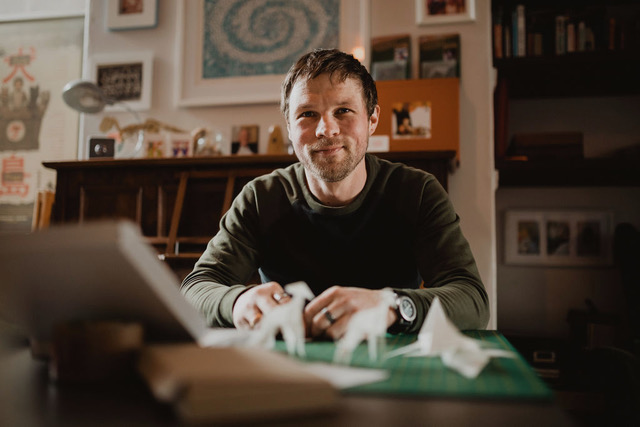
What challenges were there in the technique you chose to you?
It was challenging to make stop-motion with paper. The models (and parts of models) needed changing regularly, as the feet (which had pins in them) would tear, the tin foil joints would wear out, the paper would get grubby from finger grease etc. I made around 50 models, maybe more… It was challenging to make stop-motion with paper. The models (and parts of models) needed changing regularly, as the feet (which had pins in them) would tear, the tin foil joints would wear out, the paper would get grubby from finger grease etc. I made around 50 models, maybe more.
I wanted to make the set up as close to white as possible which was difficult without bleaching the models – so I decided to edge the paper and emphasise the folds in black. This might not seem like a big thing, but I also didn’t want there to be any shadows on the back wall of the set (I wanted the illusion of an open clear set). This was impossible because my studio is so small, and the puppets had to be close to the back, which cast a shadow. To fix this I edited every frame with a clear background. This took ages but it was important for the final look. People won’t notice it (!) but if the shadows were there it would be distracting and messier.
Planning the storyboard and animatic to specific timings was helpful. Even so, making specific movement with a specific frame allocation whilst still looking natural enough was challenging throughout.
What are you working on now/next?
My animation M.O is to use restricted or repurposed materials, and I spent many years working with a dog design made from toll box items. This project is called Whibbits and I sell replica models and merch to help fund the projects. I am about to launch a fundraising campaign to make a new Whibbits animation using a new ‘rusty’ style model. I hope to sell five models and some pin badges to help bring this project to life. I will get audience input to this new project by asking people to send videos of their dogs for me to use as reference.
Another related project idea is another origami animation. I have asked Robert Lang if I can animate some of his designs and he has given me permission. I’d like to do a grey whale folding process video followed by an effect of the model splashing in and out of water. I also have a long term project that is always in the back of my mind that uses a puppet made from found objects from my late nan’s flat. This project would be huge undertaking. The design, research, planning, and execution would need serious funding. If I ever did this project I would like to use real stories and voiceovers, similar to the Dog Crease Pattern process.
_
You can follow James Pollitt’s animation work here.
Interview by Carla MacKinnon
 ANIMATED DOCS