
With a strong social media following and public screenings in festivals and events around the world, Haneen Koraz and her team are bringing animation from the women and children of Gaza to a global audience.
Over the last year, the work of Haneen Koraz and her team in Gaza has grown in prominence and profile. An animator, educator and storyteller, Koraz’s work in organising animation workshops for children and women in Gaza – often under unimaginably difficult circumstances – has inspired artists and educators across the world. Active on Instagram as @animator_haneen, Koraz shares films made with participants in camps for displaced people in Gaza, as well as posting documentation from and reflection on the workshops.
It can be difficult not to feel despair when witnessing the dire circumstances under which civilians in Gaza are currently forced to exist. Koraz’s posts and the films made in the workshops counter this sense of hopelessness, showing young people who, even while dealing with immense hardship, trauma, and pressure, are able to express themselves through animation with humour and eloquence. The sense of hope, community, and resilience in these films has struck a deep chord in the international animation community and beyond.
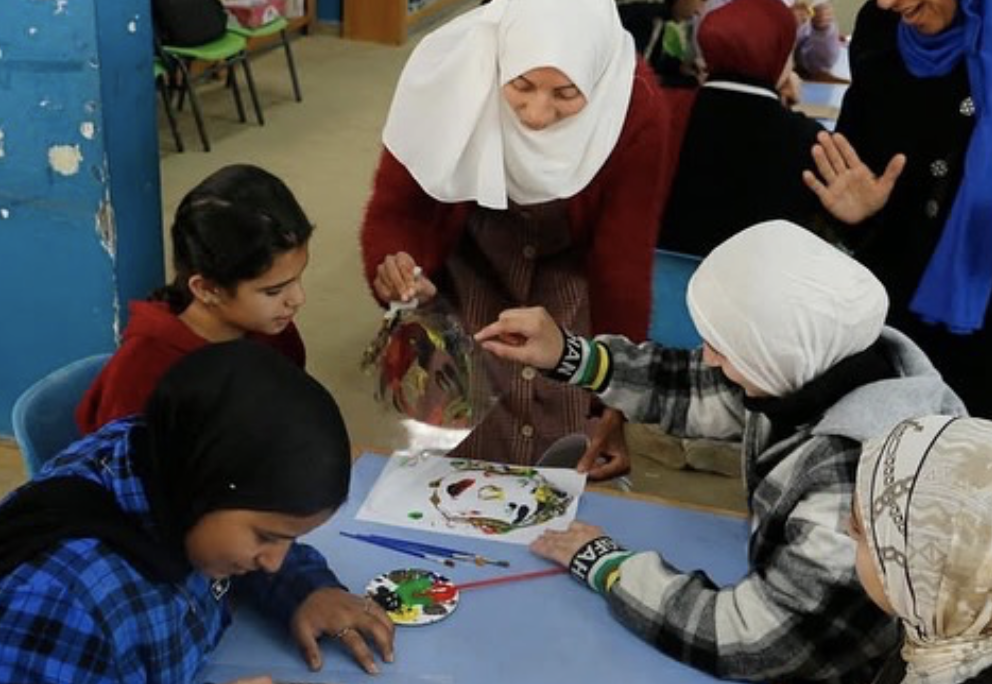
More than 30 short films produced in these workshops have been published online. They include documentary and fiction films, ranging from moving tales of daily hardship, to domestic comedy adventures in which intrepid women and children find innovative solutions to their struggles, to more poetic and metaphorical forms of expression. In ‘The Women of the Tent Speak’ (2025), eight displaced girls scripted a film in which their mothers discuss the things they miss most from their old lives – ranging from simple objects such as high heel shoes or their own cooking pan, to profound losses like absent loved ones.
In ‘Drops that Don’t Satisfy’ (2025), made by children between the ages of 10 and 15 years old in the Al-Maghazi Camp in central Gaza, the difficulty of accessing the basic materials of survival is visualised through an hourglass, its narrow middle blocking the flow of aid, as children underneath struggle to reach it.
The films have carried these voices and stories across the world, screening in countries including Portugal, Spain, Norway, Germany, Lebanon, Canada, Slovenia, and the USA. In an interview for Zippy Frames, Koraz and her colleague Nour A-Jawad note that ‘cartoons are a nice, easy way for a message to spread’ (Popp, 2025). The charm, humour, power, and accessibility of these works of animation have connected with a global audience, amplifying voices that may otherwise go unheard.

Drops That Don’t Satisfy, 2025
Koraz and A-Jawad aim to offer their workshop participants the opportunity not only to communicate their experiences, ‘to express what they’re feeling from the war and what they’re seeing every day’, but also to benefit from the process of making and creating – to ‘work with their hands to make something creative and beautiful they’re proud of’ (ibid.). Koraz has emphasised the importance of play in her work. In an Instagram post showing images of children engaging in physical play at one of her sessions, she writes ‘We play to forget this nightmare we are living, even for a few moments. We play to return to our childhood.’
Haneen Koraz is not just sharing the stories of Gaza’s women and children – she’s giving them the means to shape their own narratives, and demonstrating the power of creativity, even in the darkest times.
You can support Haneen Koraz’s work through GoFundMe or on Patreon.
References
Popp, O. (2025). “They Wanted the World to Know What They Were Going Through”: Interview With Palestinians Haneen Koraz and Nour A-Jawad (Stop-Motion Animation Workshops). Zippy Frames.
 ANIMATED DOCS