An article about this very blog, which I was invited to write for the the Society for Animation Studies blog. Blogging about blogging!
Well in this case it’s reviewing films we’ve looked at on the blog so far, in order to assess the animadoc landscape; as something of a follow-up to other articles on the site’s current theme of animated documentary.
If you haven’t checked them out already have a look at:
This animated oil-on-glass and live action documentary is centered on the campaign in Sierra Leone to get a 30% quota of women in parliament. Titles in the film explain that women took a key role in negotiating the peace process at the end of an 11 year civil war, however since then female politicians have had to deal with intimidation and misogyny as they navigate the political sidelines.
Animated Documentary reported on ‘30%’ in the early stages of production back in February 2012 and again once the film was finished and publicised by The Guardian in January 2013. And we liked it so much we felt it was worth reviewing too.
The animated sequences possess a luscious mixture of figurative and abstract imagery found most commonly in impressionism. Paint swims across the screen, smudging and slipping its sensual gloopy material around our vision with all the vibrancy of the region it refers to.
The metamorphic nature of the animated medium lends itself to turbulent tonal changes that take place in the opening sequence. The viewer zips though a busy Sierra Leone street into a viscous black void where we pass burning cars, violent gestures and feel the echoes of civil war. These melting edits are brought to great effect when combined with snappy sound design.
Following visual and audio darkness the screen literally swirls into the shape of Dr. Bernadette Lahai, one of the key political figures pushing forward the 30% quota bill. The rotoscoped image dissolves into live action. My feeling is that several of the video sequences possess considerably less flair than their animated counterparts. Such an uneven aesthetic could be said to threaten the impact of the short; but here it might be worth considering how disorientating an entirely rotoscoped 10 minute short could have been. Instead animation is reserved for storytelling and live action covers the communication of important details.
This film is fruitful both in its visuals and content. As a documentary the short conveys an under-reported theme in an engaging manor, while the animated sections are sumptuous in their appeal. At Animated Documentary we are always pleased to see such formal beauty and journalistic professionalism combined harmoniously!
Animated public information film ‘The Story of Cholera’ explicitly depicts methods of transmission, prevention and treatment of the bacterial disease in a simple and informative manner. The commissioning body, Global Health Media, explains the film ‘follows evidence-based guidelines, has been field-tested, and reviewed for accuracy and content’.
The entire sequence is strikingly utilitarian, breaking the conventional codes of pace found in mainstream film and television in order to emphasise the crucial learning points; for instance twice the viewer is left lingering on an image of a someone washing their hands properly. This film does not pull any punches; diarrhoea and vomiting is frequently depicted and explained in plain descriptive language.
Largely in black and white, colour is used to illustrate the presence of the invisible bacteria. As Western viewers we might take for granted how public health campaigns and detergent advertisements have helped us visualise how disease is spread. At the film’s resolution colour seeps into the black and white palette. This visual metaphor, despite it’s incredibly simplistic symbolism, is suitably optimistic.
The absence of lip-sync indicates one of the crucial functions of this film. Already it has been dubbed into nine languages and there are more in the pipeline. Global Health Media claim the film has been screened in 175 countries around the world. Animated Documentary wishes the campaign further success.
Nyosha is the story of a young Jewish girl who becomes fixated on a pair of shoes as the source of her salvation while her life is ripped apart by the Holocaust. Based on the diary and video recordings of Nomi Kapel, one of the young filmmaker’s grandmother, director Liran Kapel and Yael Dekel have employed both stop-motion and traditional 2D animation to render this harrowing tale.
A certain uncanny charm keeps the viewer afloat in the rippling currents of such a dejected context. Despite the truly terrible nature of the historic narrative, naïve optimism is provided by the child’s perspective. The medium also engages us with a toy like simulacra; for better or for worse this buffer dampens the emotional response to the distressing subject matter.
This towering project is impressive but by no means is it flawless. At times the stop-motion is a tad jerky, the models still have their flash lines and the illusion of scale is not fully realised. That said these are the imperfections that come hand in hand with such a challenging medium: an Aardman production, for example, would be missing a great deal if all thumbprints were removed. Set design on Nyosha is impressive and at times the lighting is too. Particular attention has been paid to attempting tricky post-production effects, like the beams of light that cut through the forest. Despite not always being entirely convincing, the over all atmosphere these create is invaluable.
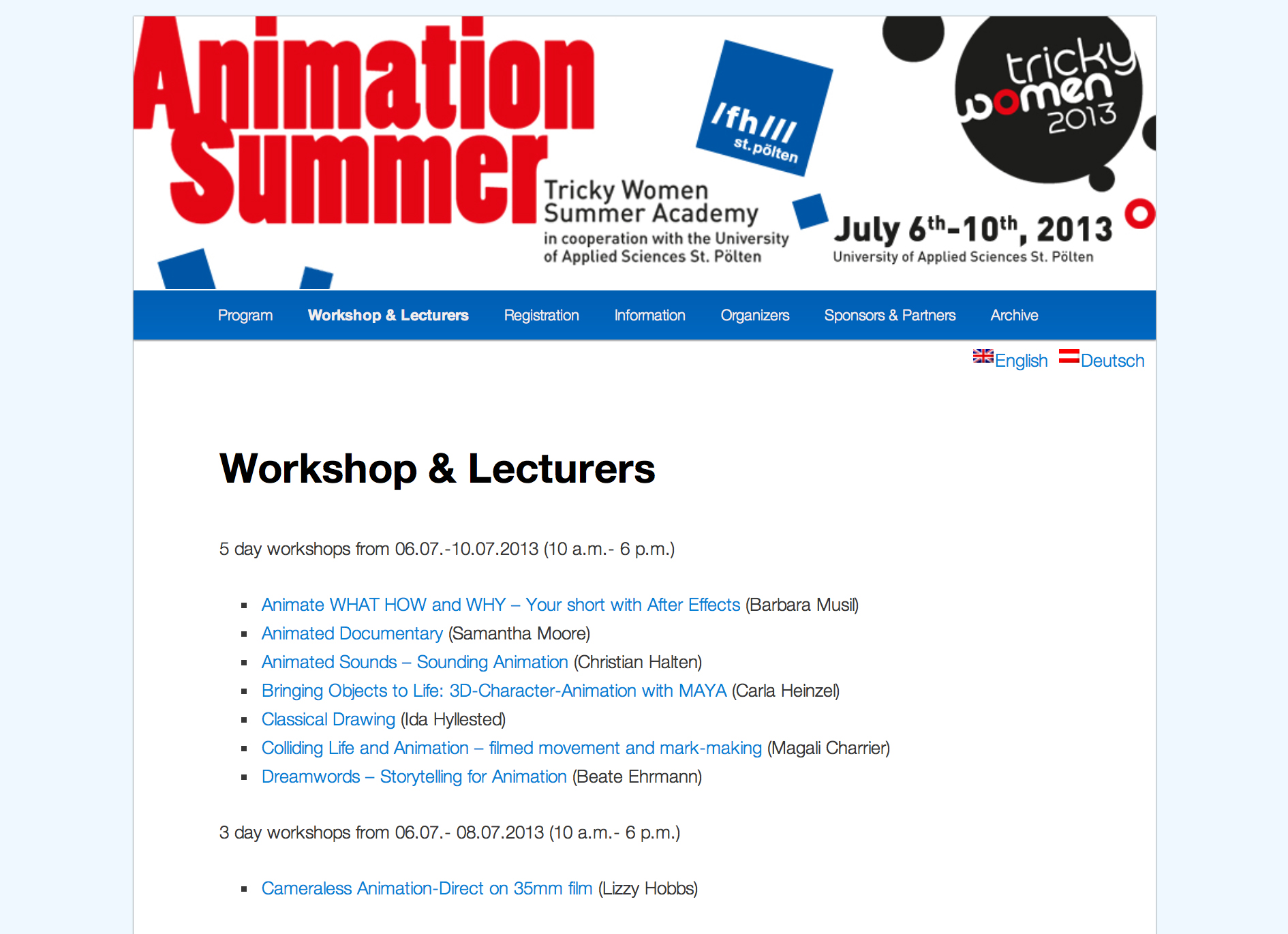
News in of the five day animadoc workshop which will run as part of Animation Summer, the Tricky Women Summer Academy, at the University of Applied Sciences in St. Polten.
Led by Sam Moore, participants will work collaboratively to produce a short film.
Recently screened as part of the animadoc programme at the Tricky Women festival, Vienna, here’s a compilation of short episodes from a series made for Australian broadcaster SBS.
In each episode a possession passed down the generations recalls memories and family histories, often of migration and war.
It seems that puppets are further crossing the threshold of reality by taking on non-fictional roles. Though this is not animation, the documentary genre is forever expanding and shifting mediums, even extending to live puppet shows.
Dan Hurlin’s ‘Disfarmer,’ is a biographical puppetry performance about the American realist portrait photographer Mike Disfarmer, whose haunting and intimate portraits of the inhabitants of rural Arkansas became iconic works of art after his death in the 1950s. Hurlin’s show sees a full stage of puppeteers share command of one lithe puppet. The show chronicles Disfarmer’s solitary existence as a reclusive artist. The show ends up almost autobiographical, with the puppet bearing far more resemblance to Hurlin than Disfarmer, their respective determined and obsessive natures becoming clear throughout the performance.
Here’s a taster of the show:
To add another ‘meta’ element to this piece, first-time filmmaker David Soll has been following Hurlin’s ‘Disfarmer’ project, creating a documentary film about the documentary performance. Soll’s film entitled ‘Puppet’ charts Hurlin’s successes and failures, as well as scrutinising the art of puppetry in general. Soll sheds light on the negative reception puppet theatre often receives among an adult demographic.
For those in London, ‘Puppet’ is being screened at The Little Angel Puppet Theatre for the ‘Puppets on Film Festival’ 12th-14th April 2013 – so watch this space for a review.
Roman Krznaric believes that developing empathy into a more highly regarded value could be the most promising approach to solving many of the world’s problems, whether they are related to climate change, violent conflicts or inequality. Krznaric’s idea of empathy as a catalyst of social change is a powerful contemporary mantra. Both practical and easily envisaged, the concept of encouraging understanding by seeing through the eyes of your counterparts has the potential to stimulate a minor revolution.
Krznaric – Britain’s leading lifestyle philosopher, as described by the Observer – is the voice of the latest in the RSA Animate series of short films: ‘illustrated’ talks selected from the free public events programme the UK charity runs ‘which seeks to introduce new and challenging thinking’.
In this episode as in others in the series, our eyes are guided across a growing mass of illustrations which concisely depict a fast stream of ideas. At times the barrage of uniformed visual and verbal information can feel tautological. At other points, one suspects, if the visual aids were missing it could be difficult to keep up with the deceptively fast current of fascinating ideas.
The animation is unconventionally diagrammatic; it lacks motion, a linear narrative or central characters. The pen wielding hand rhythmically jitters across the screen as if filling a lecture room wipe board in double time. The arm is surprisingly un-distracting, keeping our attention in time with the allegro pace of ideas. The pen directs our eyes in rhythm with the narration like a conductor’s baton.
Roman Krznaric’s Empathy project can be followed on his blog Outrospection.
Although not claiming to be an animated documentary The Last 40 Miles, ‘a short animated film about life, death and compassion’, is based on a true story. The mixed media animation refers to the real life narrative of a death row inmate whom Alex Hannaford, writer and director, came across while working as a journalist covering the Texas prison system.
Not yet completed, the filmmakers have chosen to use crowd funding to raise the rest of the capital they need to pay the production costs. Crowd funding has become an integral resource for contemporary independent filmmaking. Although not a new phenomenon, the advent of social media and specially designed sights has lead to greater numbers of productions choosing this root.
Often such campaigns offer rewards in exchange for donations, the highest levels of philanthropy resulting in a credit as executive producer. Follow the link below to see how the team have used a short video to pitch to potential donators. Indiegogo, the fundraising platform also allows us to observe their progress.
In this reflective, self-referential lesson in psychoanalysis, Bechdel sketches out every inch of her conscious and subconscious. She includes immaculately drawn extracts from Winnicot, Freud and Virginia Woolf, cross referencing and applying them to some complicated relationships with the women in her life. It is impossible not to relate to this brutally honest memoir. It is even more impossible not to devour it in one sitting.
If you’re a graphic novel novice like I was, reading this will have you forever veering towards the comics section of your bookshop.
There are freshly signed copies at Gosh Comics, Soho, London.